
A work area changes. Another trade arrives. Equipment moves, access shifts and a different task needs different safety measures. Your site review has to follow the work.
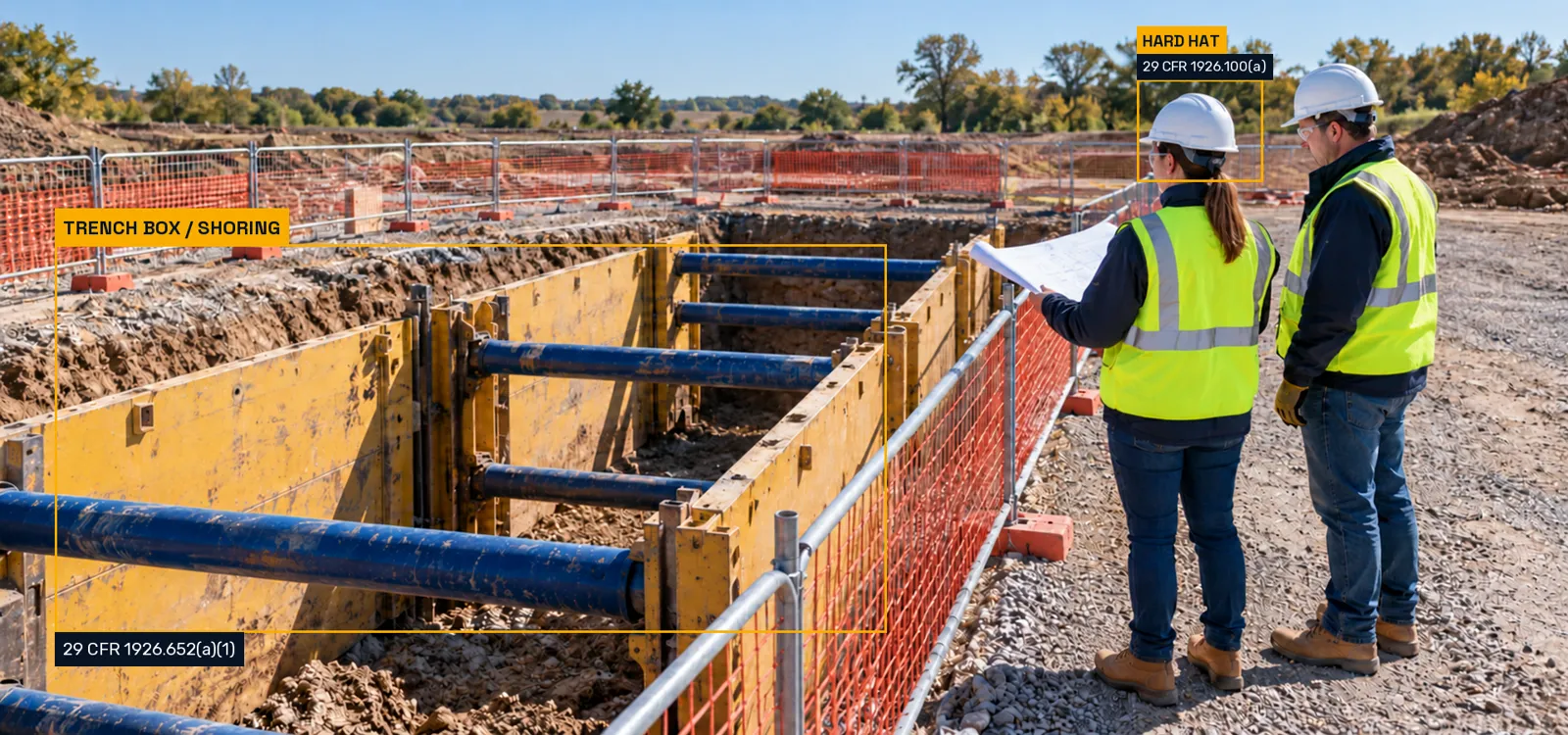
Osha Ask reviews job site video and photos and checks what it sees against OSHA requirements. It flags hazards and missing safety measures so your safety team can act on them sooner. A flag identifies the condition and the OSHA requirement it relates to.
Book a demo to see the checks on footage of a construction activity your team understands.
Build A Construction Safety Compliance Routine
Begin with the work planned for the day and the people doing it. Discuss access, adjacent activities, equipment and changes since the last review. A useful routine makes those questions specific to the project instead of repeating the same general safety reminder.
Federal construction rules require frequent and regular inspections of sites, materials and equipment by employer-designated competent persons. 29 CFR 1926.20(b)(2)
Build your working process around that responsibility. Identify who checks the conditions, how concerns reach the right person and how the team verifies the response. The checklist below supports the conversation, and the linked standards explain the requirements behind it.
Your own task plan gives the checklist its context. A ground-level material delivery and an excavation need different reviews. Use the questions relevant to the work and add the specific controls, training and documentation your project requires.
Read our guide to preparing for an OSHA construction inspection for a closer look at this topic.
Read our guide to OSHA construction penalties and citation response for a closer look at this topic.
Read our guide to competent person and qualified person roles for a closer look at this topic.
Understand The Rules Behind The Checklist
OSHA's construction standards are collected in 29 CFR Part 1926. They address different activities and exposures, including fall protection, scaffolds, electrical work and excavation. The applicable section depends on the work and conditions.
Injury and illness recordkeeping is addressed separately in Part 1904. A safety checklist and an injury log serve different purposes. Keep both connected to the responsible person and the task being performed.
State Plans can have different requirements from the federal rules. Use OSHA's State Plan directory to identify the agency covering your workplace and check its current instructions. OSHA State Plan FAQs
This page is general information, not legal advice. Use the linked standards and the people responsible for your project to assess the requirements for the actual work.
Review our construction safety glossary for a closer look at this topic.
Review our OSHA in New Jersey for construction for a closer look at this topic.
Start With The Main Site Safety Areas
Review our OSHA Focus Four construction hazards for a closer look at this topic.
Review our struck-by hazards in construction for a closer look at this topic.
Fall Protection
Identify the working surface, the exposed edge and the task before choosing protection. Under the federal rule for unprotected sides and edges, employees at 6 feet or more above a lower level need a guardrail, safety net or personal fall arrest system. Other activities have their own provisions. 29 CFR 1926.501(b)(1)
Bring the discussion to the actual work position. Consider access, movement and the protection being used. A photo can help explain an observation to the team, while the site review establishes the conditions that need attention.
Review our construction six-foot fall protection rule for a closer look at this topic.
Review our OSHA guardrail height requirements for a closer look at this topic.
Review our OSHA hole cover requirements for a closer look at this topic.
Review our construction fall protection training for a closer look at this topic.
Scaffolds
A competent person must inspect scaffolds for visible defects before each shift and after events that could affect structural integrity. 29 CFR 1926.451(f)(3)
Keep the scaffold discussion specific: the platform, access, intended use and the work happening around it. Make the current inspection information available to the people coordinating the task. Include changes after weather, movement or other events in the conversation.
Review our OSHA scaffolding rules for construction for a closer look at this topic.
Ladders
Ladders require competent-person inspections periodically and after events that could affect safe use. Structurally defective portable ladders must be identified and taken out of service until repaired. 29 CFR 1926.1053(b)(15), (16)
Review the ladder in the position where it will be used. The task, landing, surrounding traffic and condition of the equipment all belong in that discussion. A stored ladder check and the review of a ladder set up for work answer different questions.
Review our construction ladder safety rules for a closer look at this topic.
Electrical Safety
Before work begins, employers must determine whether an energized circuit could be contacted by a person, tool or machine, and address warnings and employee information as the rule specifies. 29 CFR 1926.416(a)(3)
Give electrical concerns enough context to reach the people responsible for the work. An image may show a visible condition, but the task discussion also needs information about the equipment and the work planned nearby.
Review our GFCIs and assured equipment grounding for a closer look at this topic.
Personal Protective Equipment
Construction PPE must be of safe design and selected to fit each affected employee properly. Required protective equipment must also be used and maintained in a sanitary and reliable condition. 29 CFR 1926.95(a), (c)
Connect the PPE review with the exposure and the wearer. Include the actual task in the discussion so equipment selection has a practical purpose. Check fit as part of that conversation rather than treating every worker's needs as identical.
Review our construction PPE requirements for a closer look at this topic.
Review our construction hard hat requirements for a closer look at this topic.
Review our OSHA construction silica rule for a closer look at this topic.
Excavation
Employees in excavations need cave-in protection unless the excavation is entirely in stable rock, or is less than 5 feet deep and a competent person's examination finds no indication of a potential cave-in. 29 CFR 1926.652(a)(1)
Use the excavation review to connect the protective system with current conditions and the planned activity. Access, nearby equipment and changes in the area need attention alongside the excavation itself. The companion checklist links to the relevant checks without turning the depth threshold into a blanket permission to enter.
Review our trench and excavation safety rules for a closer look at this topic.
Hazard Communication And Training
Construction hazard communication follows the requirements in 1910.1200 through 1926.59. Those requirements cover a written program, labels, safety data sheets and employee information and training, as applicable. 29 CFR 1926.59, 29 CFR 1910.1200
Employers must instruct workers in recognizing and avoiding unsafe conditions and the regulations applicable to their work. 29 CFR 1926.21(b)(2)
Use the task discussion to connect that information with what the crew will actually handle. A new product, work area or activity is a practical reason to revisit the information needed by the people doing the job.
Read our guide to OSHA 10 and OSHA 30 construction training for a closer look at this topic.
Use The Construction Site Safety Checklist
The companion checklist has 26 checks grouped by fall protection, scaffolds, ladders, electrical safety, PPE, excavation, hazard communication, training and recordkeeping. Each item links to the official rule supporting it.
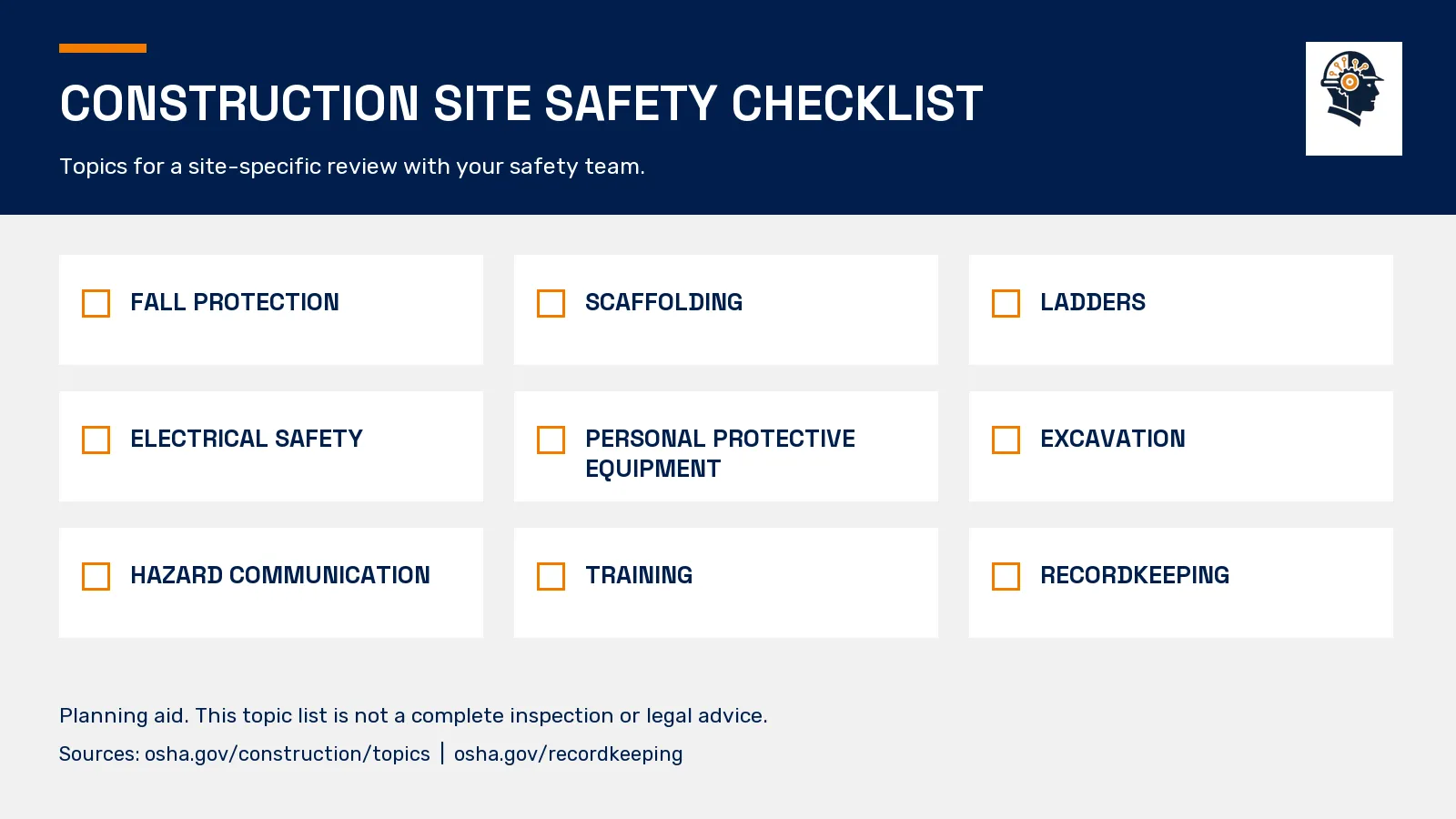
Construction Site Safety Checklist
Site: __________ Date: __________ Reviewer: __________
Use for the actual task and applicable standards. Mark each item Yes, No or N/A. Record concerns, responsible person and follow-up separately. This is a general starting point, not a complete site-specific assessment.
| Area | Check | Official Reference |
|---|---|---|
| Fall Protection | Protect unprotected sides and edges at 6 feet or more above a lower level with an allowed system. | 1926.501(b)(1) |
| Fall Protection | Protect holes against falls and other applicable hole hazards. | 1926.501(b)(4) |
| Fall Protection | Inspect personal fall arrest systems before each use; remove defective components. | 1926.502(d)(21) |
| Scaffolds | Have a competent person inspect before each shift and after integrity-affecting events. | 1926.451(f)(3) |
| Scaffolds | Provide permitted access when the platform is over 2 feet above or below access; never use crossbraces. | 1926.451(e)(1) |
| Scaffolds | Provide fall protection above 10 feet, using the system required for the scaffold type. | 1926.451(g)(1) |
| Ladders | Have a competent person inspect periodically and after safe-use-affecting events. | 1926.1053(b)(15) |
| Ladders | Tag or otherwise identify defective portable ladders and withdraw them until repaired. | 1926.1053(b)(16) |
| Ladders | Extend landing-access side rails 3 feet above the landing, or meet the rule's secured-ladder/grasping-device alternative. | 1926.1053(b)(1) |
| Electrical | Identify circuits that could be contacted; provide the warnings and employee information required. | 1926.416(a)(3) |
| Electrical | Use GFCIs or an assured equipment grounding conductor program, as applicable. | 1926.404(b)(1) |
| Electrical | Protect flexible cords from damage at sharp corners, projections and pinch points. | 1926.405(a)(2)(ii)(I) |
| PPE | Select safe-design PPE that properly fits each affected employee. | 1926.95(c) |
| PPE | Provide protective helmets where impact, falling/flying objects or electrical shock/burn hazards exist. | 1926.100(a) |
| PPE | Use appropriate eye/face protection for relevant flying-particle, chemical and radiation hazards. | 1926.102(a)(1) |
| Excavation | Provide cave-in protection unless entirely stable rock, or under 5 feet with competent-person finding of no potential cave-in. | 1926.652(a)(1) |
| Excavation | Have a competent person inspect daily before work, as needed during the shift and after rain or hazard-increasing events, when employee exposure is anticipated. | 1926.651(k)(1) |
| Excavation | In trenches 4 feet or deeper, provide safe egress within 25 feet of lateral travel. | 1926.651(c)(2) |
| Excavation | Keep spoil/equipment at least 2 feet from the edge, use sufficient retaining devices, or both. | 1926.651(j)(2) |
| Hazard Communication | Maintain the applicable written hazard communication program and workplace labeling. | 1926.59, incorporating 1910.1200(e), (f) |
| Hazard Communication | Keep required safety data sheets readily accessible during each work shift. | 1926.59, incorporating 1910.1200(g)(8) |
| Training | Instruct workers in recognizing and avoiding unsafe conditions and applicable work regulations. | 1926.21(b)(2) |
| Training | Provide appropriate scaffold hazard training for employees working on scaffolds. | 1926.454(a) |
| Recordkeeping | Maintain the latest fall-protection training certification with employee identity, date and required signature. | 1926.503(b) |
| Recordkeeping | If subject to routine records, enter recordable cases on Forms 300 and 301 within 7 calendar days of receiving information. | 1904.29(b)(3) |
| Recordkeeping | If subject to annual summaries, post the prior year's 300A from February 1 through April 30. | 1904.32(b)(5), (6) |
For each check, record whether it applies, what was observed and what the team needs to address. Add a responsible person and the next review point through your established working process.
Use the checklist before the relevant work and revisit the affected checks when conditions change. Keep the response visible to the people doing the task. A completed check is most useful when the team can explain what was reviewed and what action followed.
Where Osha Ask Fits
Check Visible Safety Measures
Osha Ask reviews job site video and photos and checks what it sees against OSHA requirements. It flags hazards and missing safety measures so your safety team can act on them sooner.
The checks cover visible conditions involving PPE, fall protection, guardrails, holes, scaffold access, ladders, trenches and housekeeping. A flag identifies the condition and the OSHA requirement it relates to.
Read The Requirement Behind The Flag
Different work calls for different provisions. The unprotected-edge rule applies at 6 feet or more; scaffold fall protection applies above 10 feet. A portable ladder used for upper-landing access generally needs side rails extending at least 3 feet above the landing, with the specified alternative when ladder length prevents that extension. 1926.501(b)(1), 1926.451(g)(1), 1926.1053(b)(1)
Use the flag and the rule to assess the actual activity. Your site review establishes measurements, exceptions and other information needed for that assessment.
Explore OSHA compliance software for the overview and AI video safety monitoring for construction for the checks and related rules.
AI helps your safety team see more; your people still make the call.
Start With A High-Risk Work Area
Choose a leading edge, scaffold access route or trench operation your safety team already needs to review. Define the activity and examine video or photos of the work area. Osha Ask checks the visible conditions against OSHA requirements and flags concerns with their related rules.
Explain the safety purpose and review process to the crew. Agree what is recorded, who reviews it and how workers can ask questions about a finding. Use a clear response process focused on the measures needed for the work.
Frequently Asked Questions
Can construction software help with OSHA compliance?
Yes. Osha Ask checks job site video and photos against OSHA requirements and flags hazards and missing safety measures with their related rules. The checks include visible conditions around PPE, fall protection, guardrails, ladders and trenches. Your safety team assesses the actual activity and handles the response through the site's process.
What are construction site regulations?
They are requirements applying to the work and exposures on a construction project. Federal OSHA construction standards appear in Part 1926, with injury and illness recordkeeping addressed in Part 1904. Start with the actual task, then use the relevant standards and the authority covering your workplace to assess what applies. OSHA Standards
Does a construction safety checklist cover every requirement?
A general checklist is a starting point for reviewing common areas of site safety. The work, hazards and applicable standards determine the checks your project needs. Use the linked references to understand each item, add task-specific requirements and connect the findings with the person responsible for the response on site.
How does Osha Ask support construction safety compliance?
Osha Ask reviews video and photos and flags visible hazards and missing safety measures with the OSHA requirement each condition relates to. Start with a high-risk area, such as a leading edge or scaffold access route, and see the checks on footage from your site. Your team assesses the findings and acts.
See Osha Ask In Your Safety Workflow
Choose a construction activity and see how Osha Ask checks the video or photos against OSHA requirements. Review a flagged condition and the rule it relates to with the safety question your team wants to examine.
Book a demo. For more product answers, explore the FAQ.
Osha Ask is an independent software product and is not affiliated with OSHA or the U.S. Department of Labor.