
An excavation review has to account for more than depth. The surrounding work, ground conditions, access, water and underground installations all belong in the discussion before entry.
Federal OSHA's Subpart P applies to open excavations, including trenches. It separates general excavation precautions from the requirements for protective systems. 29 CFR 1926.650(a), 1926.651, 1926.652
This article is general information, not legal advice. It links the federal rules for a task-specific review rather than supplying a protective-system design.
Put The Competent Person At The Center
Under Subpart P, a competent person can identify existing and predictable hazards and has authority to take prompt corrective action. The definition includes both capability and authority. 1926.650(b)
Daily inspections by a competent person are required before work and as needed during the shift, with inspections after rainstorms or other hazard-increasing events, when employee exposure can reasonably be anticipated. 1926.651(k)(1)
For the working discussion, identify that person and the conditions being assessed. Connect the inspection with the planned activity and any changes since the last review. A completed checklist is most useful when the crew knows which conditions it describes.
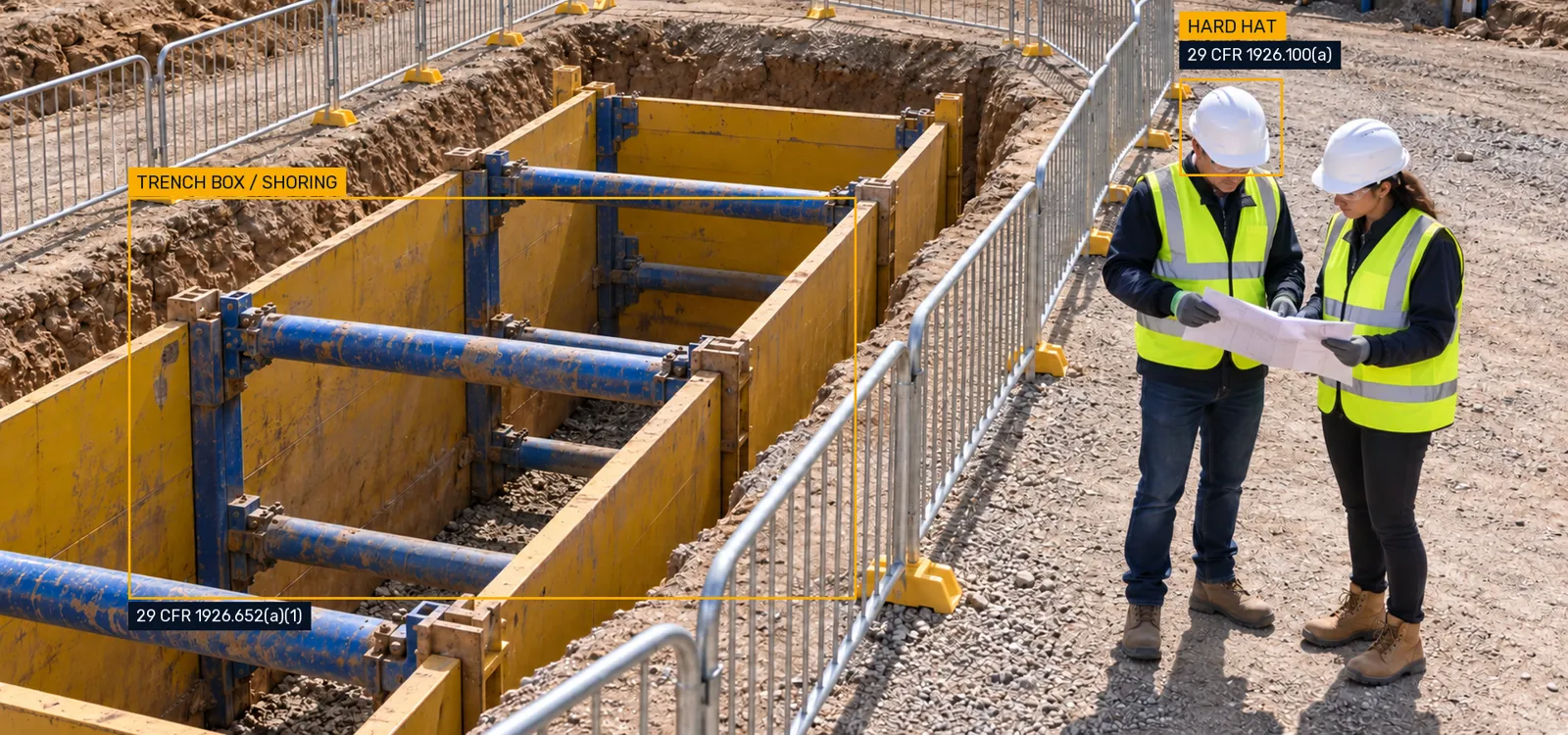
Locate Underground Installations Before Excavating
The estimated location of utility installations reasonably expected in the work area must be determined before an excavation is opened. Utility owners must be contacted as specified in the rule before actual excavation. 1926.651(b)(1), (2)
As the work approaches the estimated location, the exact location must be established through safe, acceptable means. While the excavation remains open, installations must be protected, supported or removed as necessary to protect employees. 1926.651(b)(3), (4)
Bring the utility information into the task conversation with the people doing the excavation. Useful working notes explain the location being discussed, the information available and who handles an unresolved question. Keep those notes connected to the actual work area rather than a general statement that utilities have been considered.
Understand The Cave-In Protection Rule
Each employee in an excavation needs an adequate protective system against cave-ins unless the excavation is entirely in stable rock, or it is less than 5 feet deep and a competent person's examination finds no indication of a potential cave-in. 1926.652(a)(1)
The under-five-foot exception therefore includes a condition assessment. Depth alone does not establish that protection is unnecessary. The responsible review needs to explain the ground conditions and the basis for the decision.
Protective systems include support systems, sloping, benching and shields, among other permitted protections. The definitions distinguish a shield that protects people within it from shoring that supports excavation sides. 1926.650(b)
Design choices have to follow the applicable routes in the standard. Sloping and benching are addressed in 1926.652(b), while support, shield and other systems are addressed in 1926.652(c). 1926.652(b), (c)
For trenches 20 feet deep or greater, OSHA explains that the protective system needs a registered professional engineer's design or qualifying engineer-prepared or approved tabulated data. OSHA Trenching And Excavation Fact Sheet
Keep system selection and design with the people qualified for that work. A photo can support a discussion about visible conditions; it does not supply soil analysis, engineering data or a protective-system design.
Check Access And Egress
Trenches at least 4 feet deep need a stairway, ladder, ramp or other safe means of exit positioned so workers travel no more than 25 feet laterally to reach it. 1926.651(c)(2)
The access discussion should relate to where people will actually work. Consider the work sequence and the location of equipment and materials around the route. A ladder shown in a photo is only one piece of that review; the responsible person still needs to assess the arrangement for the actual location.
OSHA also specifies design requirements for structural ramps. Employee-only ramps require a competent person's design; equipment ramps require a competent person qualified in structural design. 1926.651(c)(1)(i)
Keep Material And Equipment Hazards In View
Employees need protection from materials or equipment that could fall or roll into the excavation. The rule allows at least 2 feet of setback, sufficient retaining devices, or both where necessary. 1926.651(j)(2)
Workers must not be beneath loads handled by lifting or digging equipment. When equipment approaches an excavation edge without the operator having a clear, direct view of that edge, a warning system is required. 1926.651(e), (f)
Use the task discussion to connect movement around the excavation with the people inside and nearby. Identify the area being reviewed and the equipment activity involved. That helps the crew understand which movement or material condition needs attention.
Assess Water And Atmospheric Conditions
Employees cannot work in an excavation with accumulating or accumulated water unless adequate protective precautions are taken. Where water-removal equipment is used, a competent person must monitor its operation. 1926.651(h)(1), (2)
Where oxygen deficiency or another hazardous atmosphere exists or could reasonably be expected, the atmosphere must be tested before entry into excavations deeper than 4 feet. The rule also specifies controls, further testing and emergency rescue equipment for relevant atmospheric hazards. 1926.651(g)
A dry-looking image or an open top does not answer every atmospheric question. The task needs the information and assessment appropriate to the conditions. Use the competent person's review to resolve those questions with the people responsible for the work.
Revisit The Review When Conditions Change
If the competent person finds a possible cave-in, protective-system failure, hazardous atmosphere or another hazardous condition, exposed employees must be removed from the hazardous area until precautions have been taken to ensure their safety. 1926.651(k)(2)
Manufactured protective-system equipment must be used and maintained consistently with the manufacturer's recommendations. Damaged materials or equipment require the assessment and service restrictions specified in the rule. 1926.652(d)
For your working notes, connect each observation with the condition at that time. Explain what changed, who reviewed it and what information the crew needs next. That gives a later reader enough context to understand the review rather than simply seeing a box marked complete.
Keep The Inspection Conversation Practical
Organize the information around the excavation being assessed:
- The task, work location and expected employee exposure.
- The competent person and the conditions reviewed.
- Utility information and unresolved location questions.
- The protective system and its applicable design information.
- Access, materials, mobile equipment, water and atmosphere.
- Changes since the previous review and the response needed.
These prompts organize a discussion; the linked standards establish the requirements. Our construction safety compliance guide connects excavation checks with other common work areas and the companion site checklist.
Make The Handoff Specific
Consider a crew returning to an excavation after weather or nearby equipment activity has changed the area. The useful handoff explains which location is involved, what changed and who is reviewing the condition. It also distinguishes the current assessment from an earlier inspection made under different conditions.
Keep a photograph connected to that explanation. Identify the work area and the observation rather than treating an image by itself as the inspection record. The team can then discuss the condition with the person responsible for the assessment. This practical information flow supports the competent-person review described above; it does not replace it or establish that entry is safe.
Bring Visible Conditions Into Focus With Osha Ask
Osha Ask reviews job site video and photos and checks what it sees against OSHA requirements. It flags hazards and missing safety measures so your safety team can act on them sooner.
Review visible trench protection, access and material placement with the competent person responsible for assessing the excavation.
Explore OSHA compliance software and AI video safety monitoring for construction to see the conditions we check and the OSHA rules behind them.
Book a demo to discuss video and photo review for your construction team.
Osha Ask is an independent software product and is not affiliated with OSHA or the U.S. Department of Labor.