
Your safety manager can walk one area while work continues on several floors. A crew approaches an edge, another uses a ladder and a delivery changes the route beside a trench. Video gives you a way to review the activity shown beyond a single still image.
Osha Ask reviews job site video and photos and checks what it sees against OSHA requirements. We flag hazards and missing safety measures, together with the OSHA requirement each condition relates to, so your safety team can act.
Book a demo to see the checks on site footage.
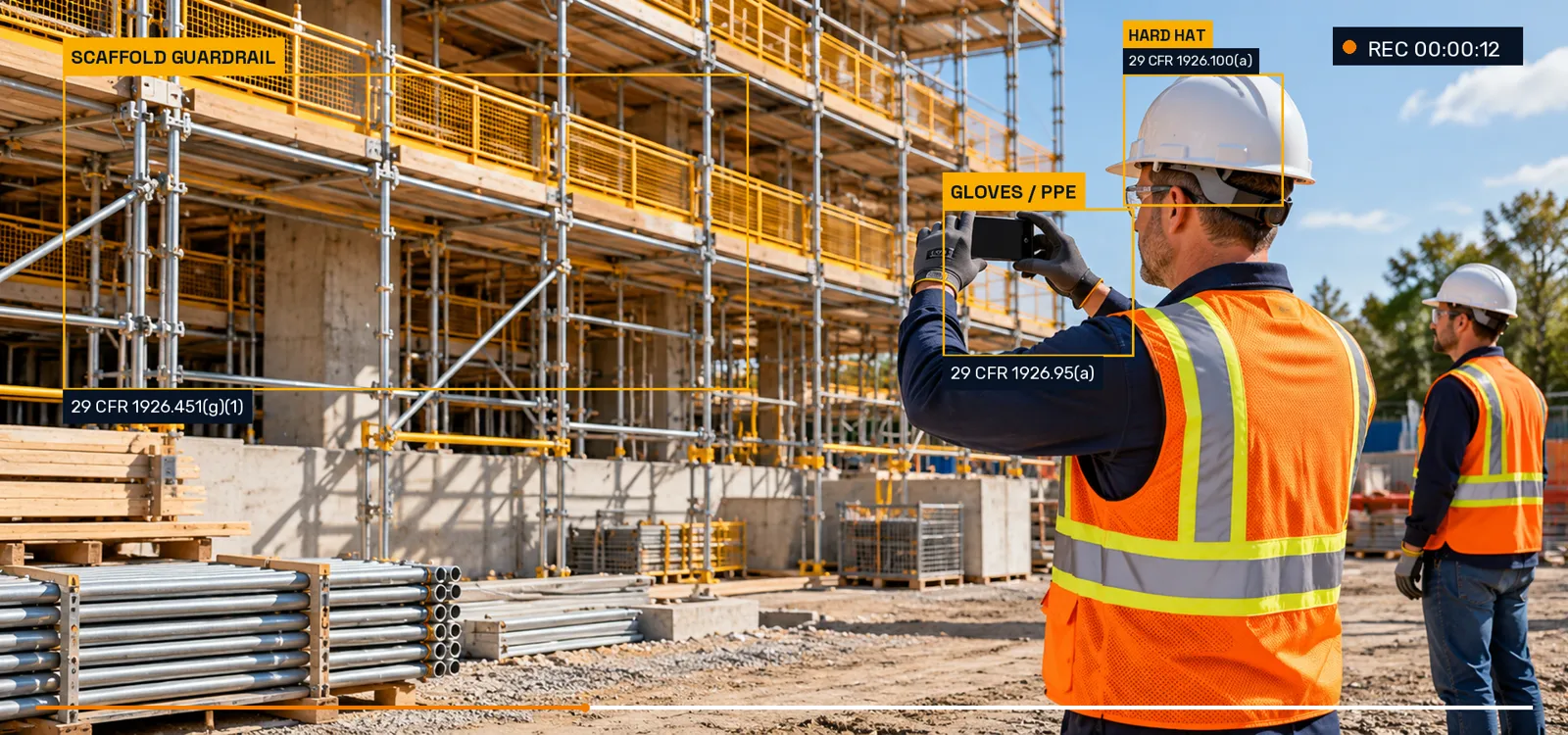
What We Check In Construction Video And Photos
The check starts with a visible condition and the requirement behind it. Your reviewer can examine the flagged concern and the rule together, then assess the actual task and the response needed.
PPE: Head, Eye And Face Protection
Footage can show workers, the tasks around them and the protective equipment visible on them. Protective helmets are required where head-injury dangers exist; appropriate eye or face protection is required for workers exposed to the listed hazards. 1926.100(a), 1926.102(a)(1)
Osha Ask flags visible PPE concerns and the OSHA requirement the condition relates to.
Fall Protection At Unprotected Edges
Video can show the work position, movement beside an edge and visible protective measures. A worker at an unprotected side or edge 6 feet or more above a lower level needs guardrails, safety nets or personal fall arrest under the edge provision. 1926.501(b)(1)
We flag the exposed condition or missing visible measure with its related requirement for your safety team's review.
Guardrails
A work-area view can show missing rails or an incomplete-looking barrier. Top rails generally must be 42 inches, plus or minus 3 inches, above the working level, with intermediate protection as specified where a sufficient wall or parapet is absent. 1926.502(b)(1), (2)
Osha Ask flags guardrail concerns and the rule behind them; the site review establishes dimensions and the actual arrangement.
Holes And Skylights
Footage can show an opening, its surrounding work and whether a cover or other visible protection is present. Workers need protection against falls through holes more than 6 feet above a lower level through covers, guardrails or personal fall arrest. 1926.501(b)(4)(i)
We flag visible openings and missing protective measures with their related requirement.
Scaffolds And Access
Video can show platform activity, visible edge protection and the route used to reach the platform. Workers on scaffolds more than 10 feet above a lower level need fall protection; platforms more than 2 feet above or below an access point need a permitted route, and crossbraces are not access. 1926.451(e)(1), (g)(1)
Osha Ask flags the visible scaffold or access concern alongside its related OSHA requirement.
Ladders At Upper Landings
A video or photo can show how a portable ladder meets a landing and how people use the route. Rails must extend at least 3 feet above the landing; if ladder length prevents that, the rule specifies a secured-top and grasping-device alternative. 1926.1053(b)(1)
We flag visible ladder-access concerns with the requirement that needs checking for the task.
Trenches And Excavation Work
Footage can show the trench area, visible protective measures, materials near the edge and access. Cave-in protection is required unless the excavation is entirely in stable rock, or is less than 5 feet deep and a competent person finds no sign of a potential cave-in. 1926.652(a)(1)
Materials and equipment need at least 2 feet of setback or suitable retaining devices, or both; trenches at least 4 feet deep need safe egress within 25 feet of lateral travel. 1926.651(c)(2), (j)(2)
Osha Ask flags visible trench concerns and related requirements for the team's assessment.
Housekeeping
Video can show debris and material placement along work areas and routes. Form and scrap lumber with protruding nails and other debris must be kept cleared from work areas, passageways and stairs. 1926.25(a)
We flag visible housekeeping concerns with the OSHA requirement behind the check.
Review our construction housekeeping rules for a closer look at this topic.
Why Video Adds Useful Detail
A still image is useful for a particular moment. Video can show the steps around that moment: a worker's approach to a platform, movement through a route or changing activity beside an edge. Reviewing that sequence can help explain why a condition deserves attention.
For a safety manager covering several work areas, that is a practical reason to examine footage. You can review the activity shown, identify a concern and discuss the requirement with the people who handle the work.
Footage shows only the recorded view. It does not establish hidden conditions, soil properties, electrical test results or structural capacity.
Review our AI in construction safety for a closer look at this topic.
Start With A High-Risk Area You Understand
Choose one work area for the first review. A leading edge, scaffold access route or trench operation gives your team a specific task to examine. Identify the activity and the safety question before the demo.
For edge work, look at the work position and the protection visible around it. For scaffold access, follow how a person reaches the platform. Around a trench, examine the visible protective measures, access and material placement with the responsible site reviewer.
The linked rules make the discussion more precise. The six-foot unprotected-edge provision and scaffold ten-foot provision apply to different activities. The trench exceptions involve an assessment, not a depth number alone. Our construction safety compliance guide provides a wider checklist and official sources.
Follow A Clear Review Sequence
Capture video or photos of the work area. Osha Ask checks the visible conditions against OSHA requirements and flags concerns with their related rules. Your safety team examines the finding and handles the response through the site's process.
Keep the intended task clear when reviewing the material. A ladder used for landing access poses different questions from a stepladder used for a task. A scaffold flag needs the scaffold type and activity assessed under its provisions. The rule reference supports that focused review.
AI helps your safety team see more; your people still make the call.
Explore OSHA compliance software for the full product overview and the Focus Four guide for an informational introduction to common construction hazard categories.
Explain The Safety Purpose To Your Crew
Introduce video checks as a way to identify hazards and missing protective measures in the work area. Explain what is recorded and who reviews it. Make the process for asking questions about a finding clear to workers and supervisors.
Use examples the crew recognizes: a missing rail, an access concern or visible PPE around a task. Explain how the safety team assesses a flag and who handles the response. Give workers an opportunity to explain the activity or a change in conditions.
Agree the site's recording and data arrangements before adopting the setup. The purpose is safer work, with a clear and respectful process for the people doing it.
Frequently Asked Questions
What does AI video safety monitoring do?
Osha Ask reviews job site video and photos against OSHA requirements. It flags visible hazards and missing safety measures with the related rule, including checks around PPE, fall protection, guardrails, ladders, scaffolds, trenches and housekeeping. Your safety team assesses the actual work and the response needed for the concern.
Can Osha Ask use our existing construction site cameras?
Take your camera and device details to a demo so we can discuss the setup for your site. Start with the work area and safety question you want to examine. Osha Ask checks video and photos against OSHA requirements and flags conditions with their related rules for your team's review.
Does Osha Ask review live video?
Discuss your live-video needs in the demo, including the work area and how your team uses footage today. Our product focus is video and photo review against OSHA requirements. See the checks around a task you understand and explore how a flagged condition and its related rule support the safety review.
What hazards can the checks flag?
Checks cover visible conditions involving PPE, fall protection, guardrails, holes, scaffold access, ladders, trenches and housekeeping. Each section above explains the related OSHA requirement. A flag identifies a condition and its rule so the safety team can assess the actual task, work area and protective measures that need attention.
How does Osha Ask handle worker privacy?
Use the demo discussion to agree the recording and review process for your site. Explain the purpose to workers, identify who reviews material and establish how questions about findings are handled. Discuss recording, access, retention and deletion arrangements with the team as part of choosing a setup for the work.
Does video review replace our safety manager?
No. Osha Ask supports the safety manager with checks of video and photos and flags that identify the related OSHA requirement. Your safety team understands the work and handles the assessment and response. Use the findings to focus attention on conditions that need review through the process your site follows.
See The Checks On Site Footage
Choose a work area and see how Osha Ask checks video and photos against OSHA requirements. Review the flagged condition and the related rule with the safety question your team wants to examine.
Osha Ask is an independent software product and is not affiliated with OSHA or the U.S. Department of Labor.