
A competent person and a qualified person are defined roles in OSHA's construction standards. The terms are related to the work, but they are not interchangeable. A competent person combines hazard-recognition capability with authority to correct hazards. A qualified person demonstrates the ability to solve relevant problems through credentials or extensive knowledge, training and experience. 1926.32(f), (m)
Start with the task and the provision that assigns the duty. Then identify the person whose capability, experience and authority fit that duty. A general job title does not explain those details by itself.
This article is general information, not legal advice.
The Competent-Person Definition
Under 1926.32(f), a competent person can identify existing and predictable hazards in the surroundings or working conditions and has authorization to take prompt corrective measures to eliminate them. The definition includes both recognition and authority. 1926.32(f)
Use both parts when assigning the role. The person needs to understand the hazards relevant to the task and be able to arrange the necessary correction. Someone who can recognize a concern but has no corrective authority does not satisfy that full definition.
Make the arrangement clear to the crew. Workers need to know whom to contact about the task and how a concern reaches the person responsible while the work is active. The role should be understandable during ordinary work, not only when a document is reviewed.
The Qualified-Person Definition
Under 1926.32(m), qualification can come from a recognized degree, certificate or professional standing, or from extensive knowledge, training and experience demonstrating the ability to resolve problems related to the subject, work or project. 1926.32(m)
The relevant subject matters. Experience with one system does not explain expertise with a different design or activity. Identify the problem the person is expected to resolve and the basis for their qualification in that work.
When selecting the responsible person, keep the work information available. A scaffold design, a fall protection arrangement and an excavation inspection raise different technical and operational questions. Read the applicable standard before assuming which role it requires.
Compare The Roles
| Question | Competent Person | Qualified Person |
|---|---|---|
| Core focus | Recognizing existing and predictable hazards | Resolving relevant subject, work or project problems |
| Basis | Hazard-recognition capability plus corrective authority | Relevant credentials or extensive knowledge, training and experience |
| Corrective authority | Expressly part of the definition | Not the defining element in 1926.32(m) |
| Example | Inspecting a scaffold for visible defects | Designing a scaffold |
| What to verify | Capability for the task and authority to act | Demonstrated ability for the relevant work |
Sources: 1926.32(f), 1926.32(m), 1926.451(f)(3), 1926.451(a)(6).
The table is a starting point. A person may perform different duties when they meet the relevant requirements, but each task still needs the capability and authority its rule specifies.
Scaffolds: Design, Inspection And Erection
Scaffolds must be designed by a qualified person and constructed and loaded in accordance with that design. 1926.451(a)(6)
A competent person must inspect scaffolds and components for visible defects before each work shift and after an occurrence that could affect structural integrity. 1926.451(f)(3)
Erection, moving, dismantling and alteration must be supervised and directed by a competent person qualified in those scaffold activities. The work must be performed by experienced and trained employees selected by that competent person. Read the whole provision; its task-specific wording matters. 1926.451(f)(7)
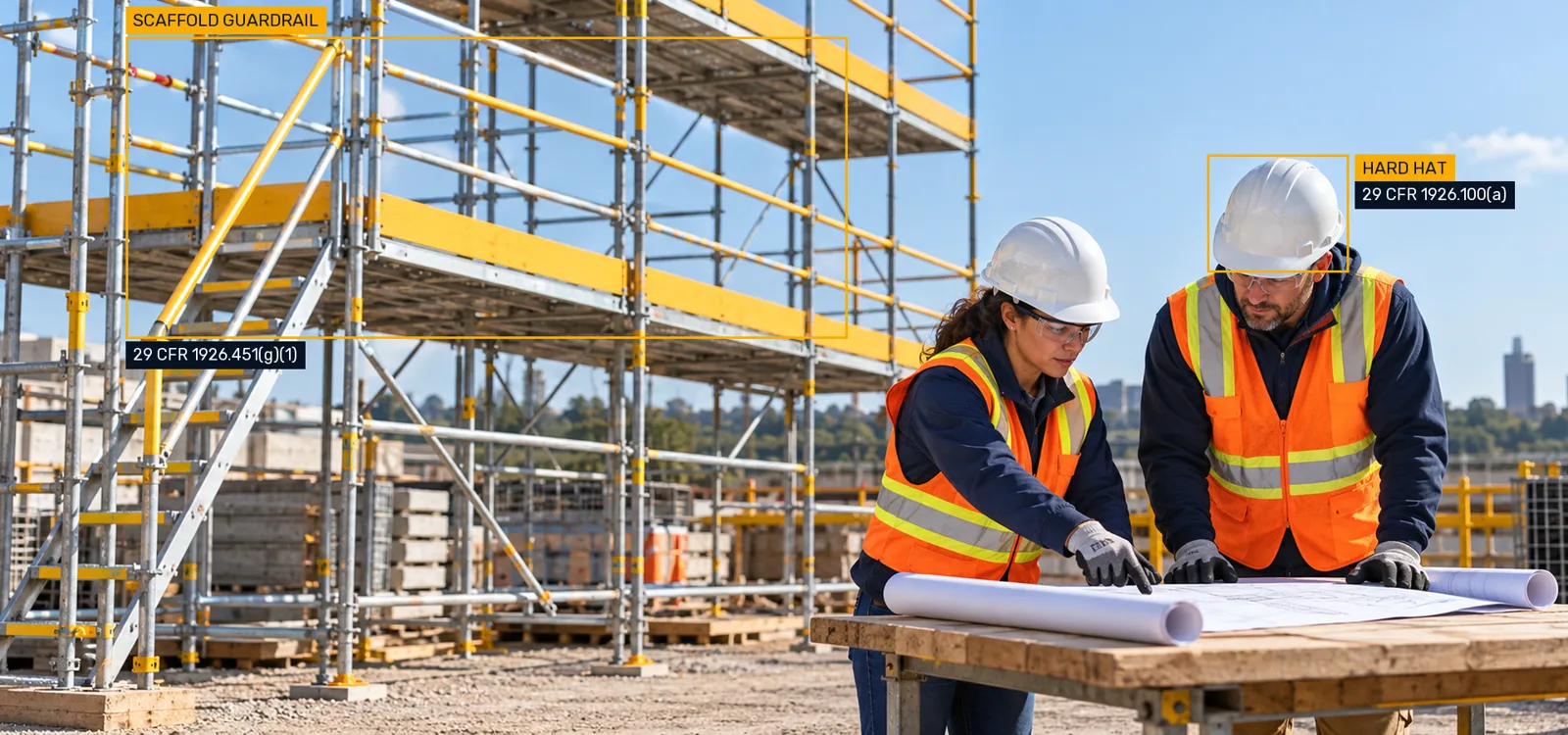
These duties show why one broad label is insufficient. Identify who handles the design, who supervises changes and who performs the required inspections. Our scaffolding guide explains the wider requirements.
Excavations: Inspect Changing Conditions
A competent person must inspect excavations, adjacent areas and protective systems daily for potential cave-ins, protective-system failure, hazardous atmospheres and other hazardous conditions. Inspections occur before work and as needed during the shift, and after rain or other hazard-increasing events, when employee exposure can reasonably be anticipated. 1926.651(k)(1)
When the competent person finds evidence of a hazardous condition, exposed workers must be removed until the necessary precautions have been taken. 1926.651(k)(2)
Keep that role connected to actual conditions and work changes. Identify who can perform the assessment and who can arrange the response during the shift. See our trench and excavation guide for the related protection duties.
Ladders: Use The Inspection Timing In The Rule
A competent person must inspect ladders periodically for visible defects and after an occurrence that could affect safe use. 1926.1053(b)(15)
Keep this timing specific to ladders. Scaffold before-shift inspection wording should not be substituted for the ladder provision. The responsible person needs to know the equipment and the event or condition prompting the review.
The ladder safety guide covers setup, landing access and removal of defective equipment alongside inspection.
Fall Protection: Read The Specific Assignment
Horizontal lifelines must be designed, installed and used under the supervision of a qualified person as part of a complete personal fall arrest system maintaining the required safety factor. 1926.502(d)(8)
For the limited situations where a fall protection plan under paragraph (k) is allowed, the plan must be prepared by a qualified person, and implementation must be supervised by a competent person. 1926.502(k)(1), (4)
Use the fall protection guide to identify the activity and applicable protection. The role assignment follows the specific provision and system involved.
Make The Responsibility Clear On Site
For each task, record who handles the duty, the basis for their capability and how the crew contacts them. This is a suggested management aid, not a universal record format imposed by the definitions.
Review the arrangement when work changes. A new scaffold system, different excavation conditions or a different protection design may require another assessment of the relevant expertise. Use the construction safety glossary and site safety guide to organize the discussion.
For example, a crew may receive a scaffold after another team has altered it. The handoff needs the person responsible for the design information, the person supervising the alteration and the competent person carrying out the inspection. Clarify those duties before treating the structure as ready for the next task. A list of names is most useful when the crew also understands what each person is responsible for checking.
Where Osha Ask Helps
Osha Ask reviews job site video and photos and checks what it sees against OSHA requirements. It flags hazards and missing safety measures so your safety team can act on them sooner. Each flag shows the related rule for review by the people responsible for the work.
AI helps your safety team see more; your people still make the call.
Explore OSHA compliance software and AI video safety monitoring.
Osha Ask is an independent software product and is not affiliated with OSHA or the U.S. Department of Labor.