The six-foot rule is a useful starting point for a construction safety discussion. It is also easy to apply too broadly. The task, working surface and type of exposure determine which fall-protection provision applies.
For employees on walking or working surfaces with an unprotected side or edge at least 6 feet above a lower level, federal OSHA requires guardrails, safety nets or personal fall arrest systems. 29 CFR 1926.501(b)(1)
That does not mean every situation below 6 feet is safe or every construction activity follows the same threshold. This article explains the federal Subpart M framework and links the rules behind the discussion.
This article is general information, not legal advice.
Start With The Task And The Surface
Before employees work on a surface, the employer must determine whether it has the strength and structural integrity to support them safely. Work is permitted only when that capacity exists. 1926.501(a)(2)
That review comes before the discussion about the edge. For the team planning the task, useful questions include where people will stand, how they will move and what is below them. Those details give the responsible person a clear picture of the work to assess.
Use a specific task rather than a general label such as "roof work." Explain the activity, the work position and the path to it. A clear description makes it easier to locate the relevant provision and discuss the appropriate protection.
What The Six-Foot Edge Rule Requires
Section 1926.501(b)(1) provides three conventional protection choices for the unprotected-side or edge situation: a guardrail system, safety net system or personal fall arrest system. The selected system also has to satisfy the applicable criteria in 1926.502. 1926.501(a)(1), (b)(1)
The review should connect the chosen protection with the worker's actual position and movement. Consider the sequence of the task, including getting to the position and moving equipment or materials. This is a practical planning discussion, not a substitute for selecting and using a system under the standard.
Keep the rule and the work description together. A note that says only "under six feet" leaves out the hazard, the surface and the activity that explain which requirement governs.
Six Feet Does Not Govern Every Situation
Subpart M directs some construction activities to other provisions, including scaffold fall protection, crane and derrick work, and steel erection. Its scope section explains those boundaries. 1926.500(a)(2), (3), (4)
Subpart M also addresses specific conditions beyond a general open edge. The relevant provisions include holes, hoist areas, ramps and walkways, roofing work, residential construction and wall openings. 1926.501(b)(3), (4), (6), (10), (11), (13), (14)
One example matters especially for the "below six feet" assumption: employees less than 6 feet above dangerous equipment must be protected by guardrails or equipment guards in the situation described by the rule. 1926.501(b)(8)(i)
Use the following as a route to the source, not a complete list of controls:
| Situation To Assess | Start With |
|---|---|
| Unprotected side or edge | 1926.501(b)(1) |
| Hole or skylight | 1926.501(b)(4) |
| Dangerous equipment below | 1926.501(b)(8) |
| Low-slope or steep-roof work | 1926.501(b)(10), (11) |
| Residential construction | 1926.501(b)(13) |
Review the hole cover requirements for a separate look at openings, covers and related hazards.
Review The Complete Protection System
The system matters as much as the category name. Section 1926.502 addresses the installation, construction and use criteria for the protections covered by Subpart M. 1926.502(a)
For personal fall arrest, an anchorage must be independent of an anchorage supporting or suspending a platform. The rule allows the specified 5,000-pound-per-attached-employee capacity route or the complete-system route with at least a two-to-one safety factor under a qualified person's supervision. 1926.502(d)(15)
The system must be rigged so a worker cannot free fall more than 6 feet or contact a lower level, alongside the other arrest requirements. 1926.502(d)(16)
Those requirements explain why "wearing a harness" is not a complete description of the setup. The review needs to address how the system works in the actual location. Keep the design, equipment and work-position questions with the people qualified to assess them.
Read the guardrail height requirements when reviewing the complete edge-protection system.
Include Rescue And Equipment Condition
The employer must provide for prompt rescue after a fall or ensure employees can rescue themselves. 1926.502(d)(20)
Personal fall arrest systems require inspection before each use, with defective components removed from service. Impact-loaded systems and components must also be removed until a competent person determines they are undamaged and suitable for reuse. 1926.502(d)(19), (21)
For the task discussion, make the rescue question concrete. Who understands the arrangement? What information needs to reach the crew? Where is the planned work position? These questions help the team recognize what it needs to resolve before the work, rather than leaving rescue as an unexplained word in a checklist.
Train For The Actual Fall Exposure
Employees who might encounter fall hazards need training to recognize those hazards and understand the procedures that minimize them. The employer must ensure training by a competent person qualified in the subjects listed in the rule. 1926.503(a)
The employer verifies training through a written record containing the employee's identity, training date and required signature, and maintains the latest record. Retraining applies when workplace or equipment changes, or gaps in understanding or skill, make it necessary under the rule. 1926.503(b), (c)
Connect the training discussion with the protection being used and the work position. A crew moving to a different task needs to understand that task's conditions, rather than relying on a general statement that everyone has received safety training.
Review construction fall protection training alongside the task and protection system.
Use A Focused Review Before The Task
For your working notes, organize the discussion around five questions:
- What task and working surface are being reviewed?
- Which specific provision applies to the exposure?
- What protection is selected for that situation?
- Who has assessed the setup, training and rescue questions?
- What change in conditions would bring the discussion back to the responsible person?
These are practical prompts for organizing information. They are not an exhaustive fall-protection plan. Add the details appropriate to the work and the applicable rule. Use our broader construction safety compliance guide to connect this review with other task areas.
Connect The Review With The Work Sequence
Consider a planning discussion about a crew moving materials across a working floor. The useful information includes the path, the edge, the location where the materials will be handled and any other activity nearby. A note that describes only the floor height leaves much of that picture unexplained.
Bring the relevant people into the conversation about those conditions. Connect the protection selected for the task with the way people will approach, move and perform the work. Record the question that needs resolution rather than assuming everyone understands an unlabeled photograph in the same way.
The same approach helps when a later shift reviews the notes. A clear task description explains what the earlier discussion covered and which conditions were present. If the work position or arrangement changes, the next reviewer has a better starting point for understanding what needs attention. This is a way to organize the discussion, not a proposed engineered protection design.
Bring Photos Into The Safety Discussion
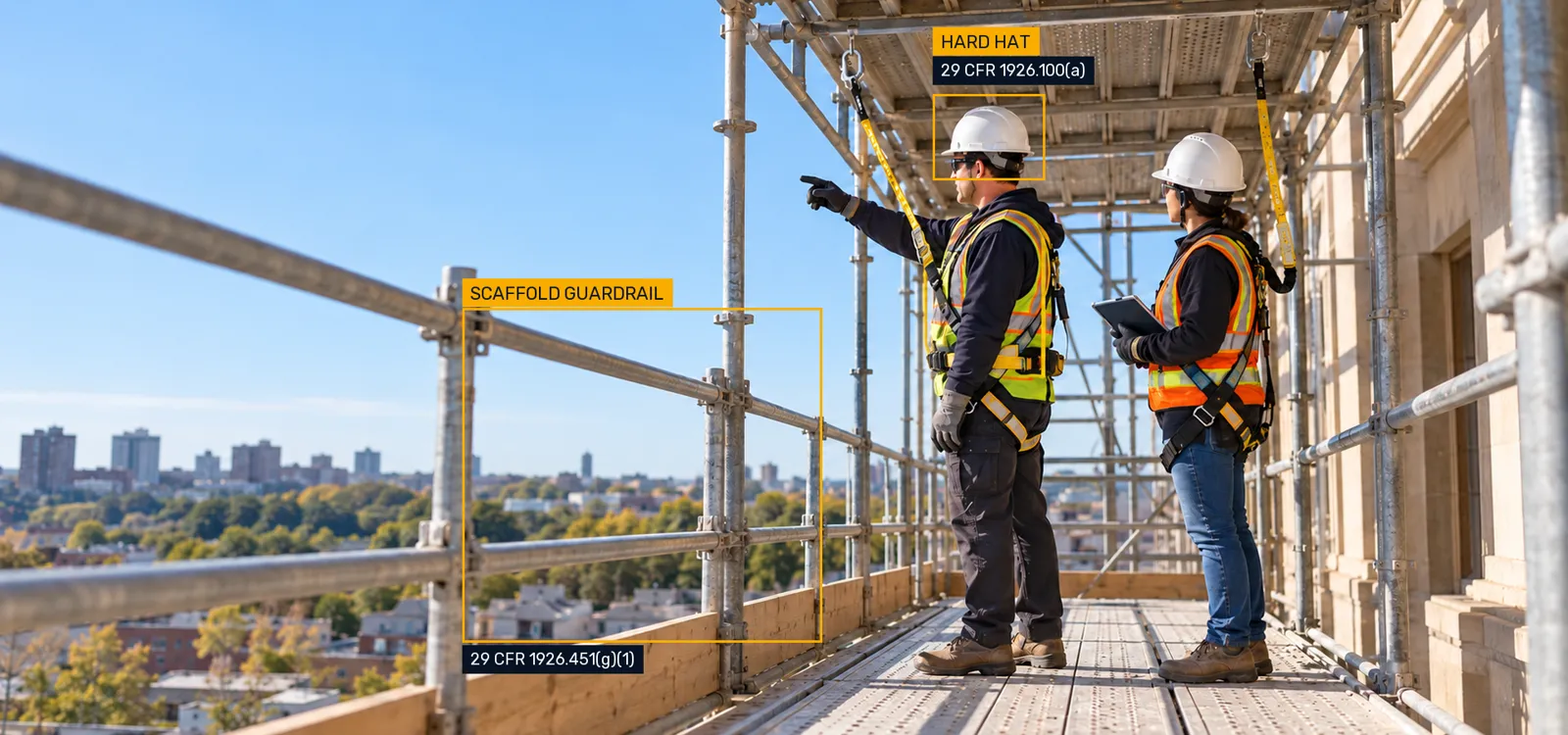
Osha Ask reviews job site video and photos and checks what it sees against OSHA requirements. It flags hazards and missing safety measures so your safety team can act on them sooner.
Review visible fall protection and guardrails against the edge, hole or working-surface requirement relevant to the activity.
Explore OSHA compliance software and AI video safety monitoring for construction to see the conditions we check and the OSHA rules behind them.
Book a demo to discuss video and photo review for your construction team.
Osha Ask is an independent software product and is not affiliated with OSHA or the U.S. Department of Labor.