
For construction guardrails covered by 29 CFR 1926.502(b), the top edge generally must be 42 inches, plus or minus three inches, above the walking or working level. That usual range is 39 to 45 inches. Height is one requirement; the complete system also needs the specified intermediate protection, strength and safe construction. 1926.502(b)(1)
Check the actual work before applying a guardrail rule. This guide covers the Subpart M criteria. Scaffolds have separate requirements, explained in our construction scaffolding guide.
This article is general information, not legal advice.
When Edge Protection Is Required
Workers on a walking or working surface with an unprotected side or edge six feet or more above a lower level need protection through guardrails, safety nets or personal fall arrest systems. Guardrails are one of the specified options for that condition. 1926.501(b)(1)
The review needs the surface, the lower level and the activity. A rail visible in a photograph does not answer whether every exposed side is protected or whether the arrangement suits the work. Have the responsible person check the whole area.
Our construction fall protection guide explains the wider six-foot rule and why different activities can have different provisions.
Top Rail Height: Measure From The Working Level
The standard measures the top edge from the walking or working level. When conditions warrant, a top edge may exceed 45 inches if the system meets all the other criteria in the paragraph. When workers use stilts, the top edge must be increased by the height of the stilts. 1926.502(b)(1)
That makes the actual work arrangement important. A change in the level from which someone works changes the height question. Review the arrangement when the task changes, including work using stilts.
Use the correct reference point during the on-site check. Record the walking or working level being assessed so the next reviewer understands the measurement. The rule concerns the installed system in use, not just the length of a rail component.
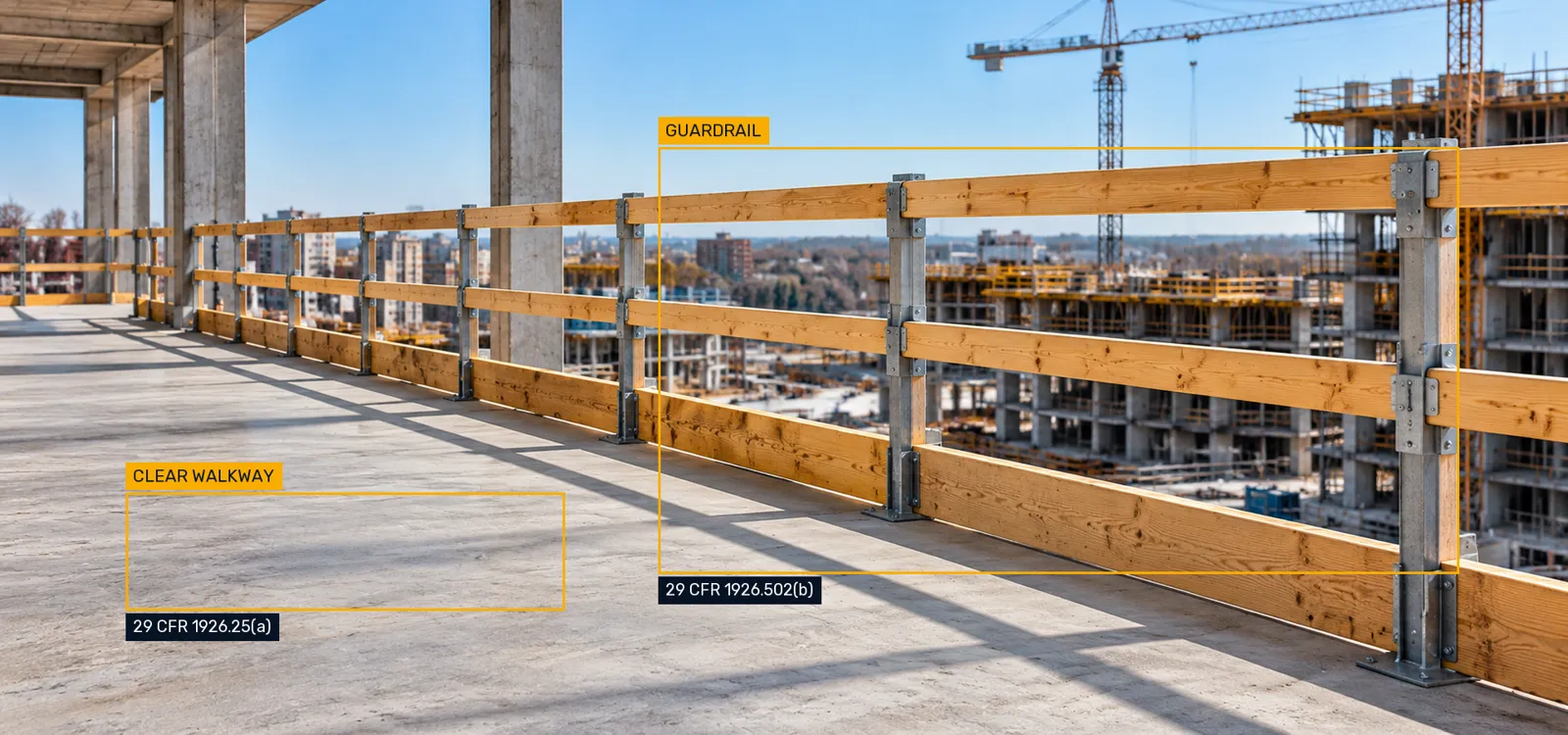
Midrails Are Midway, Not Always Exactly 21 Inches
Where there is no wall or parapet at least 21 inches high, the system needs midrails, screens, mesh, intermediate vertical members or equivalent intermediate protection. When midrails are used, they must sit midway between the top edge and the walking or working level. 1926.502(b)(2), (b)(2)(i)
With a 42-inch top rail, that midpoint is 21 inches. Use the actual top-edge height when checking the midpoint. Treating 21 inches as a universal midrail measurement can miss the relationship specified in the rule.
Screens or mesh must extend from the top rail to the walking or working level and along the opening between supports. Intermediate vertical members must be no more than 19 inches apart. Other structural-member arrangements cannot leave openings wider than 19 inches. 1926.502(b)(2)(ii), (iii), (iv)
The 200-Pound Strength Requirement
The system must withstand at least 200 pounds of force without failure, applied within two inches of the top edge, at any point along it, in an outward or downward direction. Under the specified downward load, the top edge cannot deflect below 39 inches above the walking or working level. 1926.502(b)(3), (4)
Midrails and the other intermediate members have a separate strength criterion: at least 150 pounds in an outward or downward direction without failure. 1926.502(b)(5)
These are performance requirements for the system. A photograph, a visual estimate or an informal push does not establish its load capacity. Use the appropriate design and installation information and have the responsible people assess the arrangement.
Check The Whole System
Rails need surfaces that prevent punctures, lacerations and snagged clothing. Rail ends must not project beyond terminal posts in a way that creates a projection hazard. Steel and plastic banding cannot be used as top rails or midrails. 1926.502(b)(6), (7), (8)
When guardrails protect a hole, they must cover every unprotected side or edge. Hole access points such as ladderways need a gate or an offset arrangement that prevents someone walking directly into the hole. 1926.502(b)(11), (13)
Walk the protected area with its use in mind. Look at corners, access points and material-handling locations. Identify who checks the protection after another activity changes the arrangement.
A Focused Guardrail Review
| Review Point | Question For The Site Check |
|---|---|
| Applicable rule | What surface, task and fall exposure are involved? |
| Top edge | What is its height above the actual working level? |
| Intermediate protection | Does the arrangement satisfy the relevant criteria? |
| Strength | What supports the system's design and installation? |
| Access | Could someone walk directly through an opening? |
| Work changes | Who checks protection after the layout changes? |
For example, a crew may complete one phase and hand the area to workers performing a different task. Review the working level, access and protection before the next activity begins. A handoff should identify the arrangement being used and the person responsible for checking it.
Use the construction safety compliance guide to keep guardrails connected to the wider review of access, PPE and nearby work.
Where Osha Ask Helps
Osha Ask reviews job site video and photos and checks what it sees against OSHA requirements. It flags hazards and missing safety measures so your safety team can act on them sooner. Missing or visibly incomplete guardrails can prompt a closer on-site review of the protection and the related rule.
AI helps your safety team see more; your people still make the call.
Explore OSHA compliance software and AI video safety monitoring, or book a demo.
Osha Ask is an independent software product and is not affiliated with OSHA or the U.S. Department of Labor.