
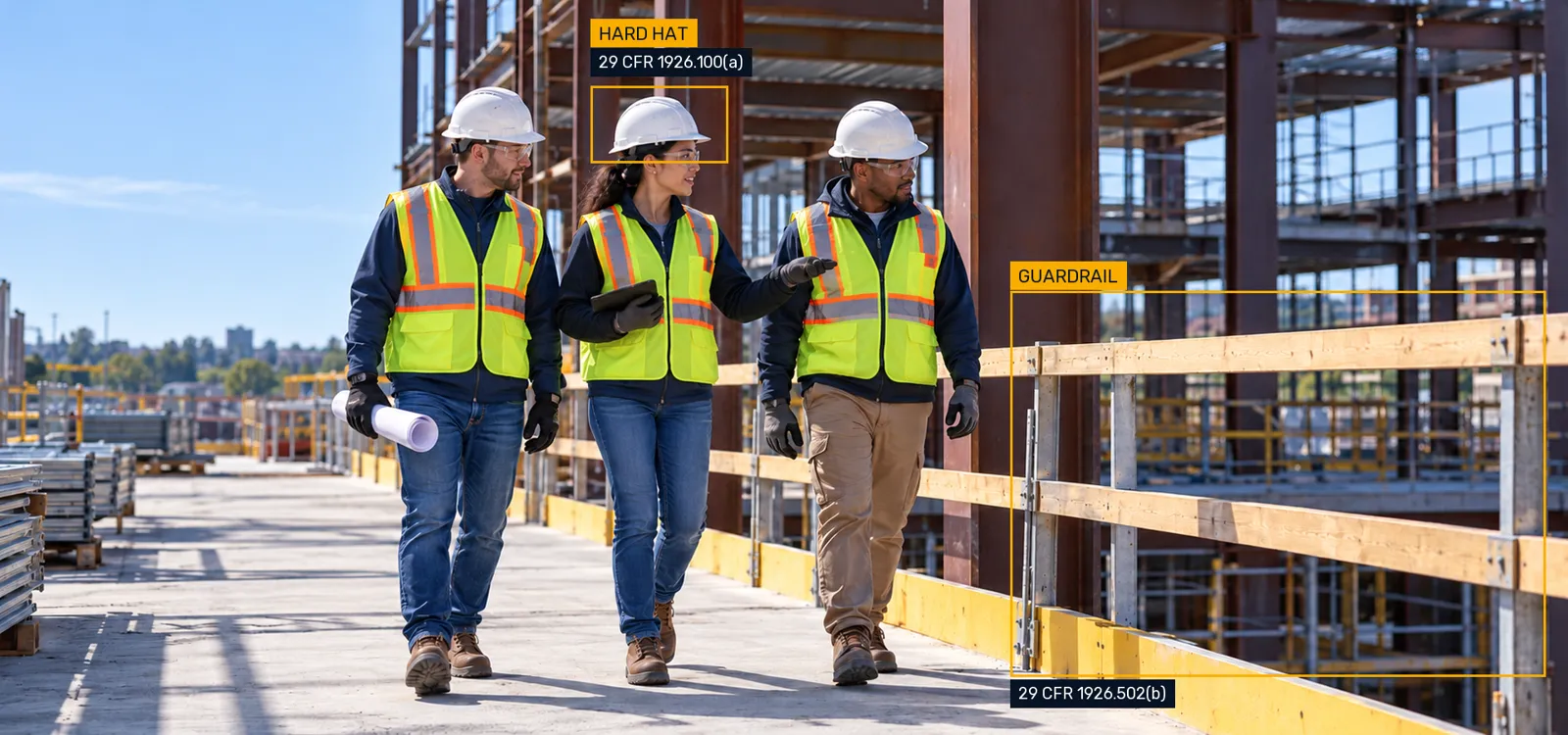
A site walk is more useful when it follows the work. Where are people moving? What can fall, move, trap or carry electrical energy? Which task is about to change the conditions around the crew?
OSHA's Construction Focus Four training groups the discussion around falls, struck-by hazards, caught-in or between hazards, and electrocution. The agency provides training materials for each category. OSHA Construction Focus Four Training
Use these categories to organize a task-specific review. They do not replace the standards governing the work or cover every hazard on a construction project.
This article is general information, not legal advice.
1. Falls: Start With The Working Position
For an unprotected side or edge on a walking or working surface at least 6 feet above a lower level, federal OSHA requires a guardrail, safety net or personal fall arrest system. Other tasks and conditions have their own provisions. 1926.501(b)(1)
Subpart M's scope directs activities such as scaffold work and steel erection to their applicable provisions, so one height threshold should not be applied to all construction work. 1926.500(a)
For the site-walk conversation, identify the actual work position and route to it. Discuss floor edges, openings, changes in level and the protection used for the task. A note that says only "fall protection checked" leaves the next reviewer without much context.
Useful observations explain which location was reviewed and what activity was planned there. A photo can help the team discuss visible conditions, while the responsible people assess the setup and the work sequence. Bring questions about the system back to those qualified to resolve them.
Our construction six-foot rule guide explains the edge provision, its limits, equipment review, rescue and training sources.
2. Struck-By Hazards: Follow Movement And Materials
Review the work around moving vehicles, stored materials and overhead activity. The category is a prompt to examine how an object or equipment could reach a person, rather than a single rule applying identically to every task.
Materials stored in tiers must be secured against sliding, falling or collapse. The storage standard also addresses clear passageways and material-specific arrangements. 1926.250(a), (b)
For covered off-highway job-site motor vehicles with an obstructed rear view, reversing requires an audible reverse alarm or an observer signaling that it is safe. Different equipment may be governed by other provisions. 1926.601(a), (b)(4)
On a site walk, describe the interaction. Is a delivery arriving where pedestrians are moving? What is being stored beside the route? Which overhead activity is occurring? Identify the people who need to coordinate the work rather than leaving the observation as a general warning about trucks.
Where falling-object exposure exists, Subpart M requires protective helmets and one of the additional protective approaches specified in the rule. A helmet alone does not replace the rest of that assessment. 1926.501(c)
Keep observations tied to the task, location and movement being assessed. That gives the team enough information to discuss the appropriate control.
Read our guide to struck-by hazards in construction for a closer look at vehicle, equipment and load concerns.
3. Caught-In Or Between: Examine Trapping Points
This part of the review includes conditions where a person could be caught in moving equipment or between objects, as well as excavation cave-ins. OSHA's Focus Four training provides a dedicated caught-in or between module. OSHA Focus Four Training
Exposed moving equipment parts that create a hazard must be guarded, and point-of-operation hazards require the guarding specified by the tools standard. 1926.300(b)(2), (3), (4)
Excavation employees need cave-in protection unless the excavation is entirely stable rock, or less than 5 feet deep with a competent person's examination finding no potential cave-in indication. 1926.652(a)(1)
Bring the task and its movement into the review. What equipment is operating? Where do hands or bodies approach it? Is another object limiting the person's movement? For excavations, who has assessed the ground and protective system?
Describe what was observed without treating the photograph as an equipment design review or soil test. Our trench and excavation safety guide covers the competent-person role, protective systems and related entry precautions with official links.
4. Electrocution: Understand The Energy Exposure
Before work, the employer must determine whether an energized circuit could be contacted by a person, tool or machine, and provide the warnings and information specified by the rule. 1926.416(a)(3)
Construction ground-fault protection follows the GFCI or assured equipment grounding conductor program requirements in Subpart K. The applicable details depend on the circuit, receptacle and equipment arrangement. 1926.404(b)(1)
For the site-walk discussion, identify temporary power, equipment use, cord routes and work near energized circuits. Give the observation enough location and task information to reach the person responsible for the electrical assessment.
Visible condition is only part of the picture. A photo does not establish circuit status, grounding continuity or the result of an electrical test. Keep those questions with the appropriate review and testing process.
Our construction electrical safety guide explains GFCIs, assured grounding and the related federal provisions.
Connect The Four Categories With The Task
A single activity can bring several categories into the same conversation. A delivery near an excavation, for example, raises questions about movement, the excavation edge, equipment positioning and access. That is an illustration of review scope, not a conclusion that a particular setup is safe.
Use the categories to avoid overlooking part of the task. Record the location, activity and condition rather than marking each hazard category as complete without explanation. Then connect the observation with the person who can assess the response.
Federal construction rules call for frequent and regular inspections by employer-designated competent persons and instruction in recognizing and avoiding unsafe conditions. 1926.20(b)(2), 1926.21(b)(2)
Make Site-Walk Notes Useful To The Next Person
For each observation, consider these working prompts:
- Identify the work area and the task underway or about to begin.
- Describe the visible condition and the people or activities involved.
- Connect the concern with the applicable rule or qualified review.
- Identify the next conversation or action your team needs.
- Explain what changed when the observation is revisited.
These prompts organize information. The actual task determines which inspections, training, protective systems and documentation requirements apply. Use the construction safety compliance guide and its checklist to connect the review with other site topics.
Keep the discussion clear enough for someone who was not on the walk. An unexplained image can mean different things to different people. A location and a task description help the reviewer understand the concern without having to reconstruct the entire job from memory.
Support The Review With Osha Ask
Osha Ask reviews job site video and photos and checks what it sees against OSHA requirements. It flags hazards and missing safety measures so your safety team can act on them sooner.
Review visible fall protection, PPE, guardrails, ladders and trenches against the requirement identified with the condition.
Explore OSHA compliance software and AI video safety monitoring for construction to see the conditions we check and the OSHA rules behind them.
Book a demo to discuss video and photo review for your construction team.
Osha Ask is an independent software product and is not affiliated with OSHA or the U.S. Department of Labor.