
Temporary power changes as a job progresses. A cord that supplied a saw yesterday may cross a new access route today. A different trade may connect equipment before the electrical contractor sees the change. Electrical safety needs a clear plan for the supply, the equipment and the work nearby.
OSHA's construction electrical rules are in 29 CFR 1926 Subpart K. Ground-fault protection is one part of that framework, alongside wiring methods and protection from contact with circuits. 1926.404, 1926.405, 1926.416
This article is general information, not legal advice.
Know Which Ground-Fault Protection Method Covers The Work
For employee protection from ground faults on construction sites, the rule provides for either approved ground-fault circuit interrupters or an assured equipment grounding conductor program. These provisions apply in addition to other equipment-grounding requirements. A grounding pin alone does not establish that the required protection program is in place. 1926.404(b)(1)(i)
Start with a simple question for the person responsible for temporary power: which method covers this equipment and location? The answer should be specific enough that a supervisor can explain it to the next trade arriving on site. An assumption that another contractor handled it leaves the crew without a clear answer.
Where OSHA Requires GFCI Protection
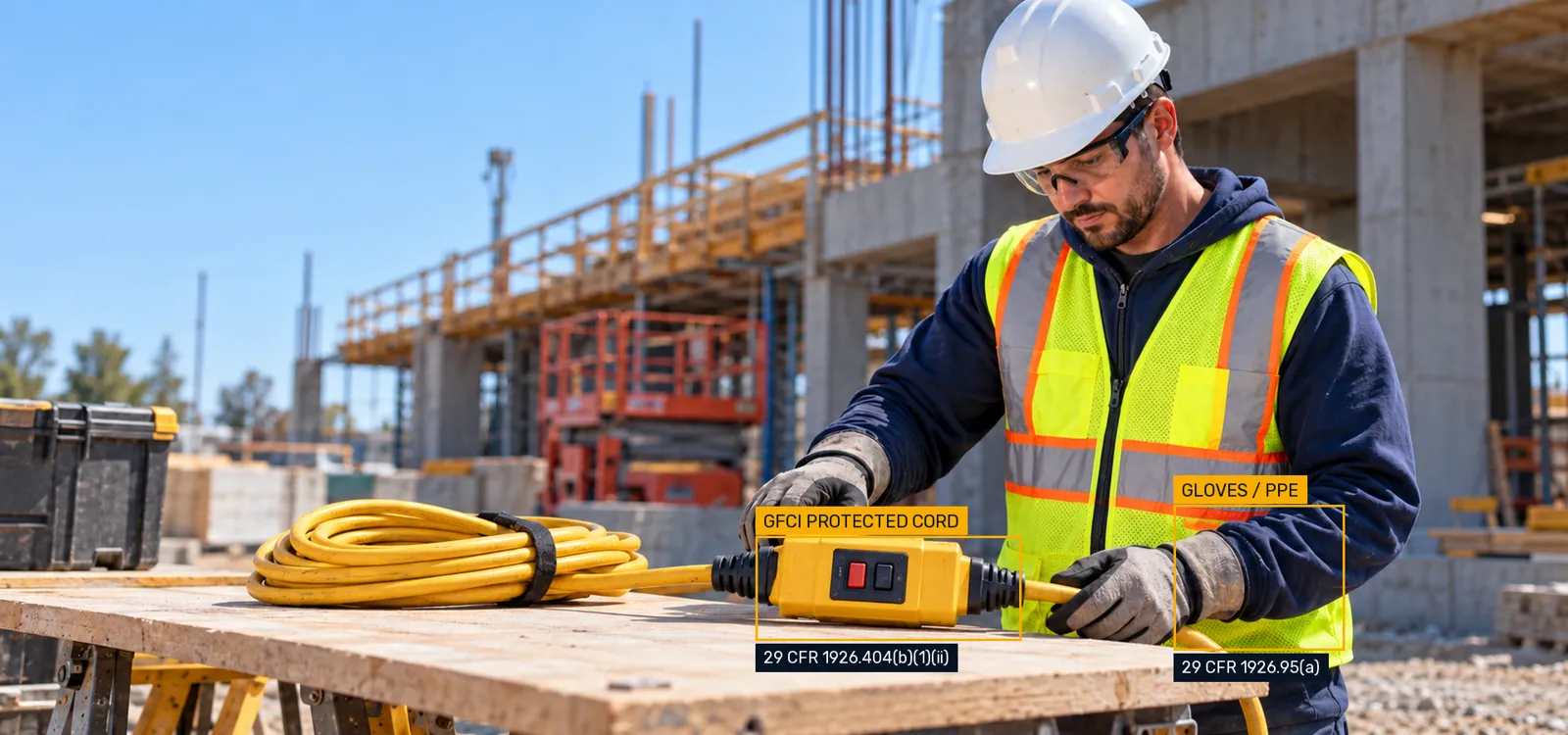
The GFCI provision covers 120-volt, single-phase, 15- and 20-ampere receptacle outlets on construction sites that are not part of the permanent wiring and are used by employees. Approved GFCIs protect personnel using those outlets. An assured equipment grounding conductor program is the alternative described in the same section. 1926.404(b)(1)(ii), (iii)
Avoid turning this into a slogan that every outlet on every project has the same rule. Identify the circuit and its use. The standard also has a narrow exception for certain two-wire, single-phase portable or vehicle-mounted generators rated no more than 5 kW, with circuit conductors isolated from the frame and other grounded surfaces. It is not a blanket generator exemption. 1926.404(b)(1)(ii)
Keep the discussion about the actual installation. The presence of a device in a photograph cannot show whether it operates correctly. Have the responsible electrical personnel establish the protection arrangements and the checks appropriate to the equipment.
What An Assured Equipment Grounding Conductor Program Includes
An assured equipment grounding conductor program, or AEGCP, is a defined inspection and testing program. It requires a written description available at the jobsite and one or more designated competent persons to implement it. 1926.404(b)(1)(iii)(A), (B)
The program includes visual inspections before each day's use for cord sets, their plugs and receptacles, and cord-and-plug-connected equipment. Fixed cord sets and receptacles not exposed to damage have a stated exception. Equipment showing damage or defects must stay out of use until repaired. 1926.404(b)(1)(iii)(C)
OSHA also requires grounding-conductor continuity and correct terminal-connection tests. Testing occurs before first use, after repairs, after suspected damage before return to service, and at intervals no longer than three months. Fixed cord sets and receptacles not exposed to damage have a six-month maximum interval. 1926.404(b)(1)(iii)(D), (E)
Records identify the equipment that passed and its last test date or applicable test interval. OSHA's eTool explains that the records and program description must be available to inspectors and affected persons on demand. OSHA AEGCP eTool
Color coding may help crews recognize program status, but a colored mark needs to mean something in the site's actual program. Ask who performed the required checks, what the mark represents and where the supporting record is kept. A color convention without the inspection and test process is not the program.
Protect Cords Throughout The Shift
Flexible cords and cables need protection from damage, including sharp edges and pinch points. Passing them through doorways is allowed when protection prevents damage. Extension cord sets used with portable tools and appliances must be three-wire types designed for hard or extra-hard use. 1926.405(a)(2)(ii)(I), (J)
Worn or frayed cords cannot be used. Cords also cannot be stapled, hung from nails or suspended by wire. Workspaces and walkways must be clear of cords that create hazards. 1926.416(b)(2), (e)
Walk the route from the supply to the tool. Look at where doors close, carts turn and material deliveries cross. A change in work layout can expose a previously protected cord. Include those routes when coordinating the next phase, especially when several trades share a floor.
Locate Circuits Before The Task Starts
Before work, the employer must determine whether exposed or concealed energized circuits could contact a person, tool or machine during the task. Where those circuits exist, employees need warning signs and information about the location, hazards and protective measures. 1926.416(a)(3)
Protection from contact requires deenergizing and grounding the circuit, or effective guarding by insulation or other means, under the applicable provision. 1926.416(a)(1)
Ask about the work sequence before drilling, demolition or equipment movement begins. A clean-looking wall or ceiling does not identify concealed circuits. The planning conversation needs the people who know the installation and the people whose tools or equipment may enter the area.
Keep Deenergized Circuits Inoperative
Construction circuit-control requirements address more than switching something off. Equipment or circuits that are deenergized must be rendered inoperative and tagged at every point where they could be energized. Tags must clearly identify the equipment or circuits being worked on. Controls deactivated during the work also require tagging. 1926.417(a), (b), (c)
This is a coordination issue as well as an electrical one. The supervisor needs to know who controls the work area and who can authorize changes. A second crew arriving later should receive the same information. Leave the electrical procedures to the personnel responsible for that work.
A Practical Temporary-Power Review
Use these questions during planning and site coordination. They organize the review without replacing the electrical inspection or test procedures:
| Review Question | Information To Establish |
|---|---|
| What supplies the work area? | Source, intended loads and responsible electrical contact |
| Which ground-fault method applies? | GFCI protection or the site's written AEGCP |
| Who checks equipment condition? | Inspection responsibility and removal process |
| Where can cords be damaged? | Doorways, traffic routes and material handling |
| What changes during this phase? | New work areas, equipment and trade handoffs |
| Who controls circuit status? | Responsible personnel and communication before work |
Consider a fit-out crew moving into a newly enclosed floor. The power source may be unchanged, but doors, staging and access routes are different. Review the cord routes and the protection method before the crew starts. That short handoff makes the electrical plan relevant to today's layout.
Electrical exposure is one of the OSHA Focus Four construction hazards. Include it in the wider construction safety compliance routine, alongside access, fall protection and housekeeping.
Where Osha Ask Helps
Osha Ask reviews job site video and photos and checks what it sees against OSHA requirements. It flags hazards and missing safety measures so your safety team can act on them sooner. A cord without GFCI protection on temporary power, or a damaged cord in a walkway, can prompt a closer look by the person responsible for the electrical work.
Electrical testing, circuit status and concealed wiring require the appropriate on-site checks. AI helps your safety team see more; your people still make the call.
See OSHA compliance software and AI video safety monitoring for construction. Book a demo to see Osha Ask check job site footage.
Osha Ask is an independent software product and is not affiliated with OSHA or the U.S. Department of Labor.