
A ladder check needs to cover the equipment and the way it will be used. The same ladder can present different questions when it is stored, set up beside traffic or used to reach an upper landing.
Federal construction ladder rules appear in 1926.1053. Training requirements are addressed in 1926.1060. Use the provisions for the actual ladder and task rather than substituting a general height rule from another activity. 1926.1053, 1926.1060
This article is general information, not legal advice.
Start With The Intended Task
Ladders must be used for the purpose they were designed for and cannot be loaded beyond their maximum intended load or the manufacturer's rated capacity. 1926.1053(b)(3), (4)
Describe the work before selecting the equipment. Is the ladder providing access, or is the worker performing a task from it? What needs to be handled, and where is the landing? Those details help the responsible person assess whether the arrangement fits the work.
Keep the design and capacity questions tied to the actual ladder. A photograph of its position does not establish its rating, condition or suitability for a different activity. The selection discussion needs the equipment information as well as the view of the site.
Check Condition And Remove Defective Equipment
A competent person must inspect ladders periodically for visible defects and after events that could affect safe use. Portable ladders with structural defects must be clearly identified or tagged and withdrawn from service until repaired. 1926.1053(b)(15), (16)
The federal ladder provision says periodic inspections and event-triggered inspections. It should not be rewritten as a different universal inspection interval without identifying another applicable requirement.
In working notes, identify the ladder and the condition reviewed. Explain what the observation means for the next person handling the equipment. If the ladder is being removed from use, keep that information connected to the equipment so the issue does not get lost between crews.
Oil, grease and other slipping hazards must be kept off ladders. 1926.1053(b)(2)
Review The Surface And Surrounding Activity
Use ladders on stable, level surfaces unless secured against accidental displacement. Slippery surfaces require the precautions described in the rule; slip-resistant feet do not replace care in placement and securing. 1926.1053(b)(6), (7)
Ladders in locations where work or traffic could displace them must be secured or protected by a barricade keeping that activity away. The areas around the top and bottom must be clear. 1926.1053(b)(8), (9)
Bring nearby activity into the setup discussion. A doorway, delivery route or changing work area can matter even when the ladder itself appears undamaged. Explain the activity and location so the reviewer can assess the arrangement as it will be used.
Understand The Four-To-One Angle Guidance
For non-self-supporting ladders, the general rule places the foot approximately one-quarter of the ladder's working length horizontally from the top support. Working length is measured along the ladder between the foot and top support. 1926.1053(b)(5)(i)
This is often shortened to "four to one," but the wording matters. Do not silently substitute the total ladder length or another dimension for the working length in the rule. Wood job-made ladders with spliced side rails have a different specified angle. 1926.1053(b)(5)(ii)
The top of a non-self-supporting ladder must support both rails equally unless it has a single-support attachment. 1926.1053(b)(10)
Use a clear task view when discussing the position. A close-up of the feet alone may not show the upper support, while a close-up at the top may omit the base and surrounding activity.
Check The Three-Foot Landing-Access Rule
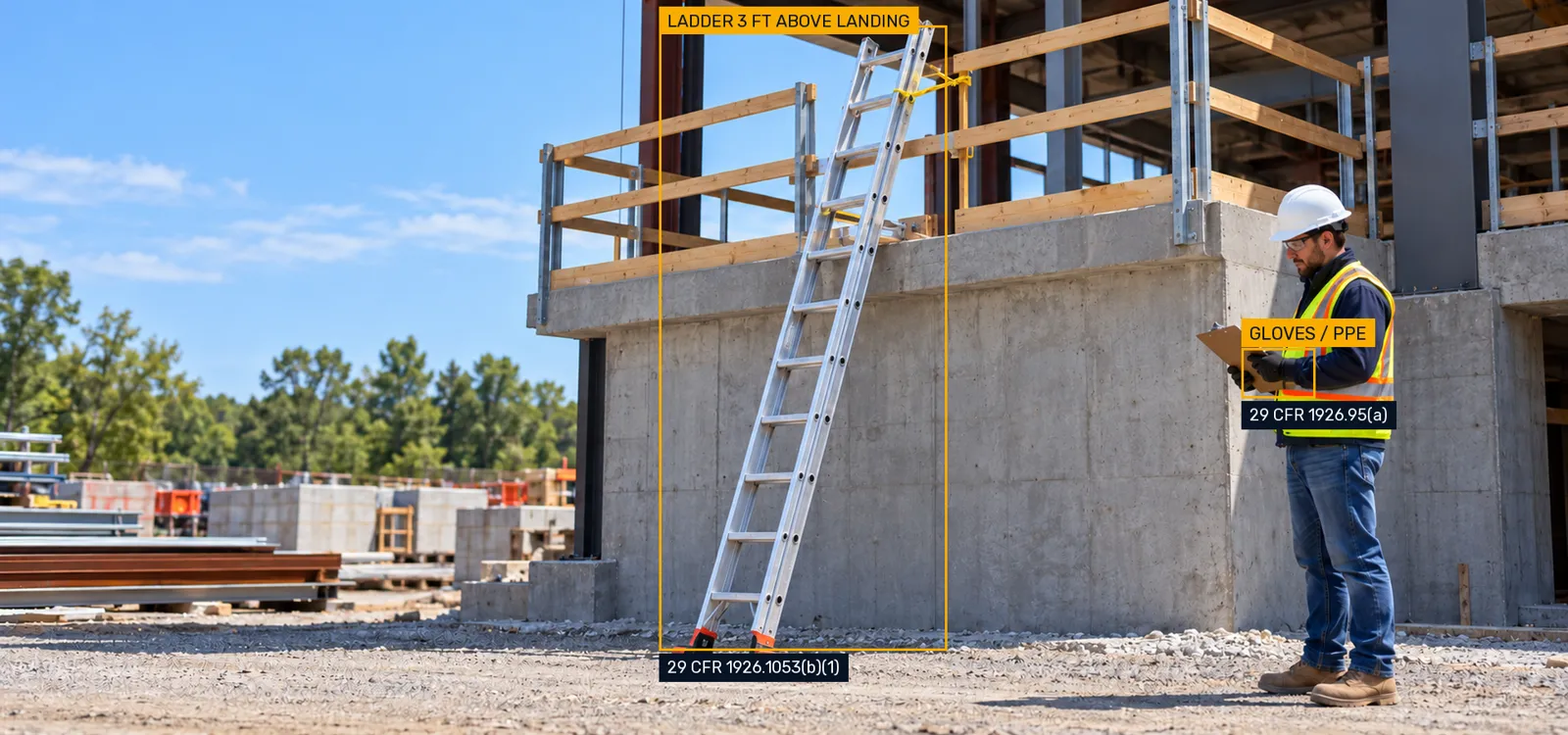
For portable-ladder access to an upper landing, the side rails must extend at least 3 feet above the landing. If the ladder's length makes that extension impossible, the rule provides a secured-top and grasping-device alternative, with conditions preventing deflection from causing the ladder to slip. 1926.1053(b)(1)
Read the complete alternative before describing a shorter extension as acceptable. The rule is about a usable access arrangement, not simply a number visible beside a roof edge.
Keep the access task distinct from the fall-protection requirements for the work performed after someone reaches the landing. Our construction fall-protection guide explains why the working activity and applicable provision matter.
Use Stepladders As Designed
Stepladders need the spreader or locking device specified to hold the sections open during use. Their top or top step cannot be used as a step. Rear crossbracing is not for climbing unless the ladder is designed with climbing steps on both sides. 1926.1053(a)(8), (b)(13), (14)
For the crew discussion, describe the work position and the reach required. A setup question is easier to resolve when the responsible person knows where the task is, what the worker needs to handle and which ladder is being considered.
Avoid treating a stepladder and a leaning access ladder as interchangeable arrangements. The relevant instructions and provisions need to match the equipment and its actual use.
Address Climbing And Electrical Exposure
Workers must face the ladder when ascending or descending, use at least one hand to grasp it and avoid carrying a load that could cause a loss of balance and fall. Ladders cannot be moved, shifted or extended while occupied. 1926.1053(b)(11), (20), (21), (22)
Where the worker or ladder could contact exposed energized electrical equipment, nonconductive side rails are required, subject to the specified power-transmission exceptions. 1926.1053(b)(12)
Include the surrounding task in that review. The ladder's material does not answer every question about nearby energized equipment. Connect the concern with the people responsible for assessing the work and the energy exposure.
Train For The Equipment And The Task
Employers must provide necessary ladder and stairway training so employees recognize the hazards and understand procedures to minimize them. A competent person provides the applicable training, including placement, handling, use and load capacities. Retraining is required as necessary to maintain understanding. 1926.1060
Bring a specific setup into the training conversation. Explain the route, landing, equipment and task rather than relying on the word "ladder" to describe every situation. That makes the information more useful for the crew and the person reviewing the work.
Connect The Observation With The Response
Useful ladder notes identify the equipment, work area, planned activity and concern. Add enough context for the next reviewer to understand what was observed. When the setup changes, explain the change rather than assuming a previous photo describes the new arrangement.
Our construction safety compliance guide places ladder checks alongside other work areas. If a ladder is part of scaffold access or a ladder-jack scaffold, also use the relevant scaffold rules rather than applying ladder guidance alone.
Support The Review With Osha Ask
Osha Ask reviews job site video and photos and checks what it sees against OSHA requirements. It flags hazards and missing safety measures so your safety team can act on them sooner.
Review visible ladder use and access arrangements against the relevant OSHA requirement for the equipment and activity.
Explore OSHA compliance software and AI video safety monitoring for construction to see the conditions we check and the OSHA rules behind them.
Book a demo to discuss video and photo review for your construction team.
Osha Ask is an independent software product and is not affiliated with OSHA or the U.S. Department of Labor.