
A piece of material laid over a hole is not a complete protection arrangement. OSHA's construction rules address the cover's load capacity, securing and warning identification. The review also needs to consider people who could fall or step through the hole and people exposed to objects falling below.
The main provisions are the hole-protection duties in 1926.501(b)(4) and the cover criteria in 1926.502(i). Use both for the actual work area. 1926.501(b)(4), 1926.502(i)
This article is general information, not legal advice.
What Counts As A Hole?
In Subpart M, a hole is a gap or void at least two inches in its smallest dimension in a floor, roof or other walking or working surface. A wall opening has a separate definition. 1926.500(b)
Identify the actual location before choosing protection. A floor penetration, a roof skylight and a gap along an access route may expose workers in different ways. Include the work above, beside and below the location in the review.
The practical question is what can enter or pass through the hole during the task. Consider workers, equipment and materials, including people who may arrive after the crew that created it has left.
Falls, Trips And Falling Objects Are Separate Questions
Workers on walking or working surfaces need protection from falling through holes, including skylights, more than six feet above a lower level. The listed options are personal fall arrest systems, covers or guardrails around the hole. 1926.501(b)(4)(i)
The same paragraph separately requires covers to protect workers from tripping in or stepping into or through holes, including skylights. It also requires covers for protection from objects falling through holes. Those two provisions do not state the more-than-six-foot threshold. 1926.501(b)(4)(ii), (iii)
Check all relevant exposures. A shallow opening can still create a stepping hazard, and a hole can expose someone below to falling material. The fall-distance question is only one part of the review.
Load Capacity Depends On Where The Cover Is Used
Roadways And Vehicle Aisles
Covers in roadways and vehicular aisles must support, without failure, at least twice the maximum axle load of the largest vehicle expected to cross them. 1926.502(i)(1)
Identify the vehicle traffic expected in that location. A route change can alter the load question even when the cover itself has not moved. Keep the cover's design information tied to its actual placement and use.
Other Covers
All other covers must support, without failure, at least twice the weight of employees, equipment and materials that may be imposed at any one time. 1926.502(i)(2)
Include equipment and staged material in the assessment. A check based only on one person's weight misses the combined load described in the rule. Have the responsible people establish the capacity from the appropriate design and equipment information.
Secure Covers Against Accidental Movement
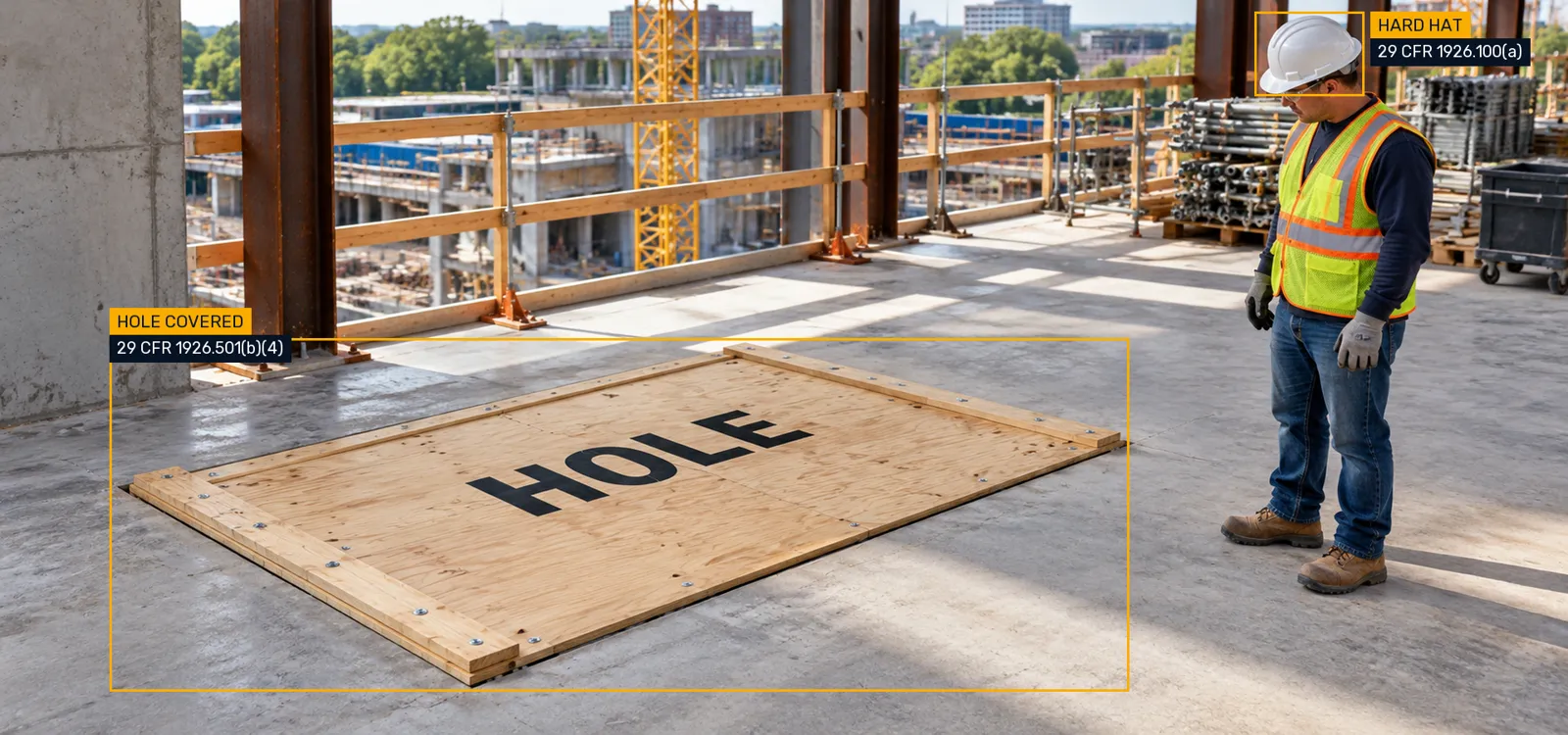
All covers must be secured when installed to prevent accidental displacement by wind, equipment or employees. 1926.502(i)(3)
Review the installed arrangement, not simply whether a panel is present. Consider the work nearby and what could disturb the cover. Keep its location clear in the handoff so another trade understands that the material is a protective cover.
If the work requires changing the arrangement, identify who controls that change and checks the protection afterward. A useful handoff describes the opening, the protection and the person responsible for restoring the intended arrangement.
Color Coding Or HOLE Or COVER Marking
Covers must be color coded or marked with the word HOLE or COVER to warn of the hazard. The paragraph's note excludes cast iron manhole covers and steel grates used on streets or roadways from this marking provision. 1926.502(i)(4)
Warning identification serves a different purpose from load capacity and securing. A clearly marked panel still needs the required strength and installation. A strong cover still needs warning identification where that provision applies.
Explain the site's identification method to the crews working nearby. A protective panel should not be mistaken for loose material available for another task.
Guardrails And Skylights
When guardrails are used around a hole, they must protect all unprotected sides or edges. Hole access points, such as ladderways, need a gate or offset arrangement so someone cannot walk directly into the hole. 1926.502(b)(11), (13)
Read our guardrail requirements guide for the related criteria. The fall protection guide explains the broader construction provisions.
Skylights are expressly included in the hole-protection duties. Check the protection arrangement for the actual skylight and work; its appearance alone does not establish cover capacity or protection for workers nearby. 1926.501(b)(4)
Review The Cover As Work Changes
Use a short site check: identify the opening, establish the expected load, review securing, check warning identification and consider work below. Revisit the arrangement when routes, equipment or material staging change.
Our construction safety compliance guide places that review alongside access, fall protection and housekeeping. Keep the opening in the crew handoff until the condition is permanently resolved.
Where Osha Ask Helps
Osha Ask reviews job site video and photos and checks what it sees against OSHA requirements. It flags hazards and missing safety measures so your safety team can act on them sooner. A visible hole or missing protection can prompt the responsible person to check the arrangement and the related rule.
AI helps your safety team see more; your people still make the call.
Explore OSHA compliance software and AI video safety monitoring, or book a demo.
Osha Ask is an independent software product and is not affiliated with OSHA or the U.S. Department of Labor.