
Construction work can place people near moving vehicles, operating equipment and materials being lifted or handled. A useful struck-by review identifies what moves, where workers travel and how the operation keeps people clear of the hazard.
Struck-by hazards are part of OSHA's construction Focus Four training, alongside falls, caught-in or caught-between hazards and electrocution. OSHA Focus Four Training
The control needs to fit the equipment and activity. Motor vehicles, earthmoving equipment, flaggers and crane loads each have specific provisions. This article is general information, not legal advice.
Start With The Movement And The Exposure
Identify the equipment or material involved, the intended route and the places where workers enter the area. Include deliveries, loading, reversing and changes in material staging. Workers from another trade may use a route that the equipment operator does not associate with the task.
Ask who controls the movement and who communicates changes. A clear route and an understood handoff help the team review the work before people and equipment converge in the same space.
Use the Focus Four guide for the broader hazard-recognition discussion and the construction safety guide to organize related site checks.
Motor Vehicles On Off-Highway Jobsites
Section 1926.601 covers motor vehicles operating on off-highway jobsites not open to public traffic. It excludes equipment addressed by 1926.602. Check that scope before applying a vehicle requirement. 1926.601(a)
Covered vehicles need an adequate, operable audible warning device at the operator's station. A vehicle with an obstructed rear view cannot be used unless it has a reverse signal alarm audible above surrounding noise or is backed only when an observer signals that it is safe. 1926.601(b)(3), (4)
Review the actual route and visibility. Identify the people walking through the area and the arrangement used when backing. Keep the observer or warning-device question tied to the applicable rule and the equipment in use.
Vehicles in use must be checked at the beginning of each shift for the safety condition of the parts and accessories listed in the standard. Defects must be corrected before the vehicle is placed in service. 1926.601(b)(14)
Earthmoving And Compacting Equipment
The earthmoving-equipment provisions address machines such as scrapers, loaders, tractors, bulldozers, graders and similar equipment. Use the actual equipment category when identifying its requirements. 1926.602(a)(1)
Bidirectional machines identified in the rule need an operable horn distinguishable from surrounding noise, used as needed while moving in either direction. Earthmoving or compacting equipment with an obstructed rear view cannot be used in reverse unless an operating reverse alarm is distinguishable from surrounding noise or an employee signals that it is safe. 1926.602(a)(9)(i), (ii)
Plan the review around the work area, not only the machine. Material stacks, another parked vehicle or a changing access route can affect the way people and equipment interact. Have the responsible people check the current arrangement.
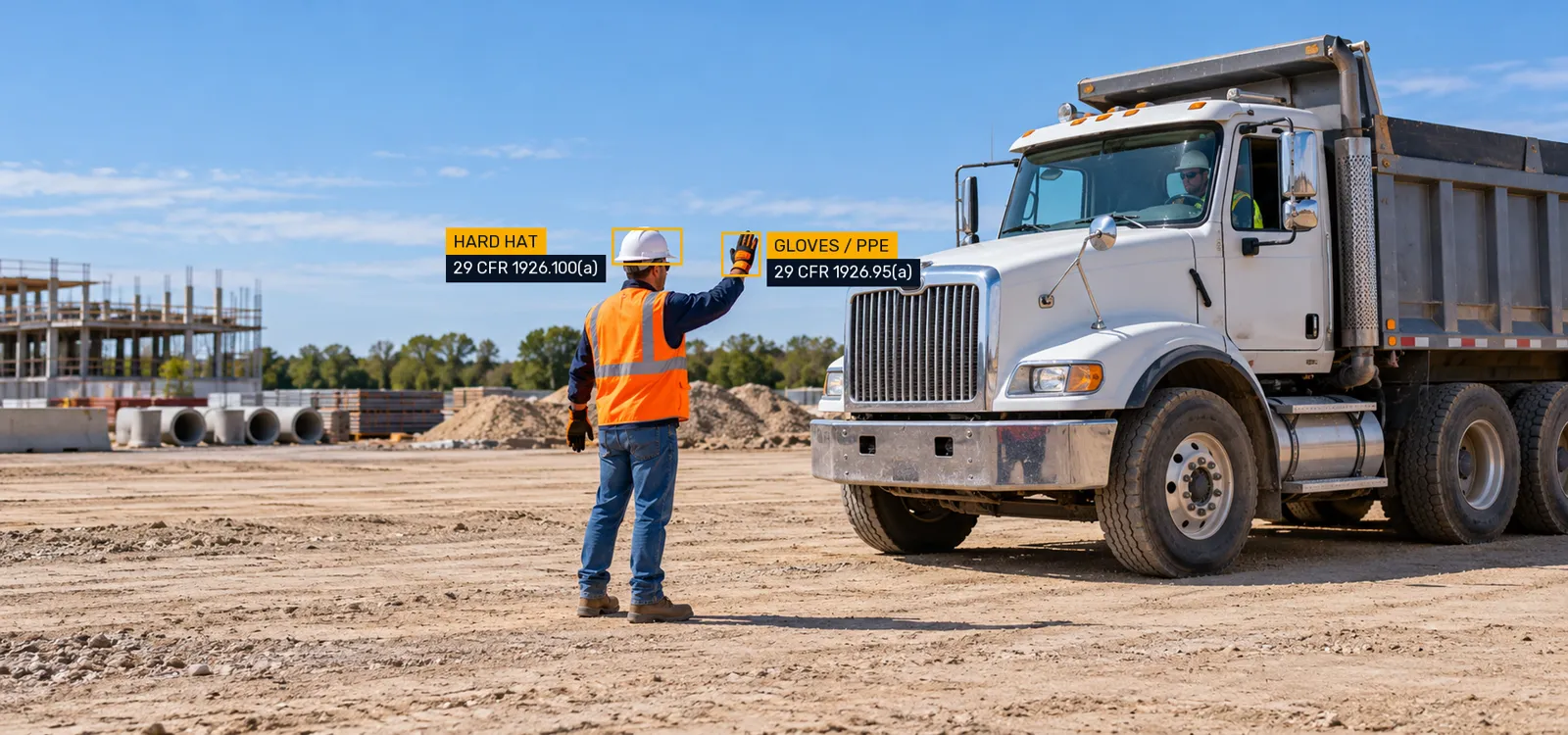
Flaggers And Warning Garments
Flagger signaling and use, including warning garments, must conform to Part 6 of the Manual on Uniform Traffic Control Devices as incorporated by reference in the construction rules. 1926.201(a)
For excavation work, employees exposed to public vehicular traffic must be provided with and wear warning vests or other high-visibility garments. Keep that requirement tied to its stated work and exposure. 1926.651(d)
Review who directs traffic, what signaling arrangement applies and how workers recognize the route. A visible garment is part of the review where required; the traffic-control arrangement needs the appropriate assessment for the operation.
Keep Clear Of Hoisted Loads
Where available, use hoisting routes that minimize employee exposure to loads, to the extent consistent with public safety. 1926.1425(a)
While the operator is not moving a suspended load, workers must stay outside its fall zone except for the activities listed in the rule, including hooking, unhooking, guiding, initial attachment or operating a concrete hopper or bucket. Additional rigging criteria apply to workers doing the specified load-handling tasks within the fall zone. 1926.1425(b), (c)
Only workers needed to receive a load may be in the fall zone when it is landed. During tilt-up or tilt-down work, no worker may be directly under the load, and only essential workers meeting the provision's conditions may enter the fall zone. 1926.1425(d), (e)
Keep the operation, route and receiving area in the lift discussion. The responsible people need to establish who performs each role and how other workers are kept clear of the affected area.
Head Protection And Falling Objects
Protective helmets are required where workers face possible head injury from impact, falling or flying objects, or electrical shock and burns. 1926.100(a)
Where the falling-object provision applies, hard hats are used alongside one of the specified controls, such as preventing objects from falling, a suitable canopy arrangement, or barricading the fall area and keeping workers out. 1926.501(c)
Our hard-hat guide explains selection, fit and care. Review the overhead work and the area below together so the protection reflects the actual exposure.
Use A Movement Review Before The Task
| Review Point | Question To Resolve |
|---|---|
| Equipment | Which rule applies to this vehicle or machine? |
| Route | Where will it travel, reverse, load or unload? |
| Workers | Who uses or crosses that area? |
| Warning and signaling | What arrangement applies and who carries it out? |
| Lift | Who needs to receive the load and who stays clear? |
| Changes | What does the next crew need to know? |
For example, a delivery may change a route used by workers on another task. Review the staging and movement before unloading begins, then explain the usable route to affected crews. Check the arrangement again after material has been placed.
The housekeeping guide covers clear passageways and stable storage, which belong in that same work-area discussion.
Keep The Crew Handoff Specific
Before another crew enters the area, explain the active movement, the route available to workers and the person responsible for coordinating the operation. Identify any change in staging that affects the planned arrangement.
Give workers a clear way to report an unexpected vehicle, obstructed route or unclear signal. The next supervisor needs the condition and location, together with the contact who can check it. After a change, review whether the intended route and work separation still fit the activity underway.
Where Osha Ask Helps
Osha Ask reviews job site video and photos and checks what it sees against OSHA requirements. It flags hazards and missing safety measures so your safety team can act on them sooner. Visible warning garments and blocked routes can prompt a closer review of the work area and the applicable protection.
AI helps your safety team see more; your people still make the call.
Explore OSHA compliance software and AI video safety monitoring.
Osha Ask is an independent software product and is not affiliated with OSHA or the U.S. Department of Labor.