
A scaffold review needs to start with the kind of scaffold, the work planned and the people responsible for its setup and use. A platform, guardrail and access route are parts of a system, not separate boxes to check without context.
OSHA's construction scaffold requirements are in Subpart L. General requirements appear in 1926.451, additional rules for particular types in 1926.452, and training in 1926.454. Aerial lifts are addressed separately in 1926.453 and are excluded from 1926.451. 1926.451
This article is general information, not legal advice.
Identify The System And Its Intended Use
Scaffolds must be designed by a qualified person and constructed and loaded according to that design. They must not be loaded above their maximum intended load or rated capacity, whichever is lower. 1926.451(a)(6), (f)(1)
The practical review therefore starts with what the scaffold is meant to support. Describe the work, number of people, equipment and materials expected on the platform. A photograph of an empty platform does not establish the load arrangement during the actual task.
Use the correct scaffold type when finding the additional requirements. Section 1926.452 addresses types such as fabricated-frame, ladder-jack and mobile scaffolds, with different provisions for their arrangements. 1926.452
Review The Foundation And Stability
Supported scaffold uprights must bear on base plates and mud sills or another adequate firm foundation. Footings must support the loaded scaffold without settling or displacement, and unstable objects cannot be used as supports. 1926.451(c)(2)
Supported scaffolds with a height-to-base-width ratio greater than four to one require restraint against tipping by the methods and arrangements specified in the rule. The requirements include details about placement and repetition of ties or braces. 1926.451(c)(1)
Bring the surrounding conditions into the review. Identify the scaffold location and any change in the supporting area. A short note about the foundation or restraint system should say what was assessed and which scaffold it concerns, rather than relying on an unlabeled close-up image.
Check Platforms In The Context Of The Task
Working levels generally must be fully planked or decked between the front uprights and guardrail supports, subject to the specified exceptions and spacing conditions. The standard also addresses width, overhang, supports and related platform details. 1926.451(b)
Do not turn one platform dimension into a complete inspection. The work position, material location and access point help explain whether the setup needs further review under the relevant provisions.
For the crew discussion, make the intended activity clear. A platform used for a particular task may have a different working arrangement from the one shown before materials arrive. Connect the inspection information with the task and the current condition.
Provide The Required Access
When a platform is more than 2 feet above or below the access point, workers must use one of the permitted access methods. Crossbraces cannot be used as access. The rule contains additional requirements for the different methods and for erection and dismantling access. 1926.451(e)
During the review, identify the route people will actually use. Explain how the route connects with the working platform and what activity is occurring around it. This gives the responsible reviewer something concrete to assess.
If the scaffold is being erected or dismantled, use the provisions addressing those activities rather than assuming the arrangement for ordinary use answers every access question. 1926.451(e)(9)
Use Scaffold-Specific Fall Protection
Employees on scaffolds more than 10 feet above a lower level require the fall protection specified for their scaffold type. The permitted arrangement varies; some scaffold types require both guardrails and personal fall arrest. 1926.451(g)(1)
That is why the general construction six-foot edge rule cannot simply be substituted for scaffold rules. Subpart M expressly directs scaffold fall protection to Subpart L. 1926.500(a)(2)(i)
The review should identify the scaffold type, the selected protection and the task being done. Our six-foot rule article explains the broader distinction between activities and thresholds.
Falling-object exposure also needs its own protective review. Subpart L addresses protective helmets and the additional measures for tools, debris and other falling materials. 1926.451(h)
Inspect Before Each Work Shift
A competent person must inspect scaffolds and components for visible defects before each work shift and after events that could affect structural integrity. Damaged or weakened components must be repaired, replaced, braced as permitted or taken out of service under the rule. 1926.451(f)(3), (4)
Keep the inspection tied to the scaffold and the conditions at the time. A record from a previous setup does not explain a later arrangement. Useful notes identify the location, the observation and the person handling the review.
The standard also addresses power-line clearances, slippery conditions, debris and storm or high-wind work. Those provisions include conditions and exceptions that need to be read for the actual situation. 1926.451(f)(6), (8), (12), (13)
Understand Setup And Training Responsibilities
Erecting, moving, dismantling or altering a scaffold requires supervision and direction by a competent person qualified for those activities, using experienced and trained employees selected for the work. 1926.451(f)(7)
Employees working on a scaffold need hazard training from a person qualified in the subject matter. Employees involved in erection, disassembly, movement, operation, repair, maintenance or inspection need the competent-person training addressed separately in the rule. Retraining applies when understanding or skill is inadequate. 1926.454(a), (b), (c)
These roles are related but not interchangeable labels. In the working discussion, identify who is responsible for the specific design, setup, inspection or training task. A generic note that someone is "trained" does not describe those different responsibilities.
Give Mobile Scaffolds A Separate Review
Mobile scaffold requirements include bracing and alignment, locks to prevent movement during stationary use, stability during movement and conditions governing any riding by employees. Read the complete conditions rather than assuming wheels make a scaffold freely movable during work. 1926.452(w)
Connect the planned movement with the route, surface and work sequence. Identify whether the question concerns stationary use, moving the scaffold or the configuration after the move. That makes the relevant review clearer for the person responsible.
Organize The Scaffold Conversation
Use the review to connect the parts of the system:
- Scaffold type and intended work.
- Design and loading information.
- Foundation, restraint, platform and access.
- Fall protection and falling-object precautions.
- Current inspection and changes in condition.
- Setup, training and review responsibilities.
These prompts support information gathering. The applicable provisions and the actual configuration determine the requirements. Our construction safety compliance guide connects scaffold review with other task areas, including the Focus Four hazards.
Support The Review With Osha Ask
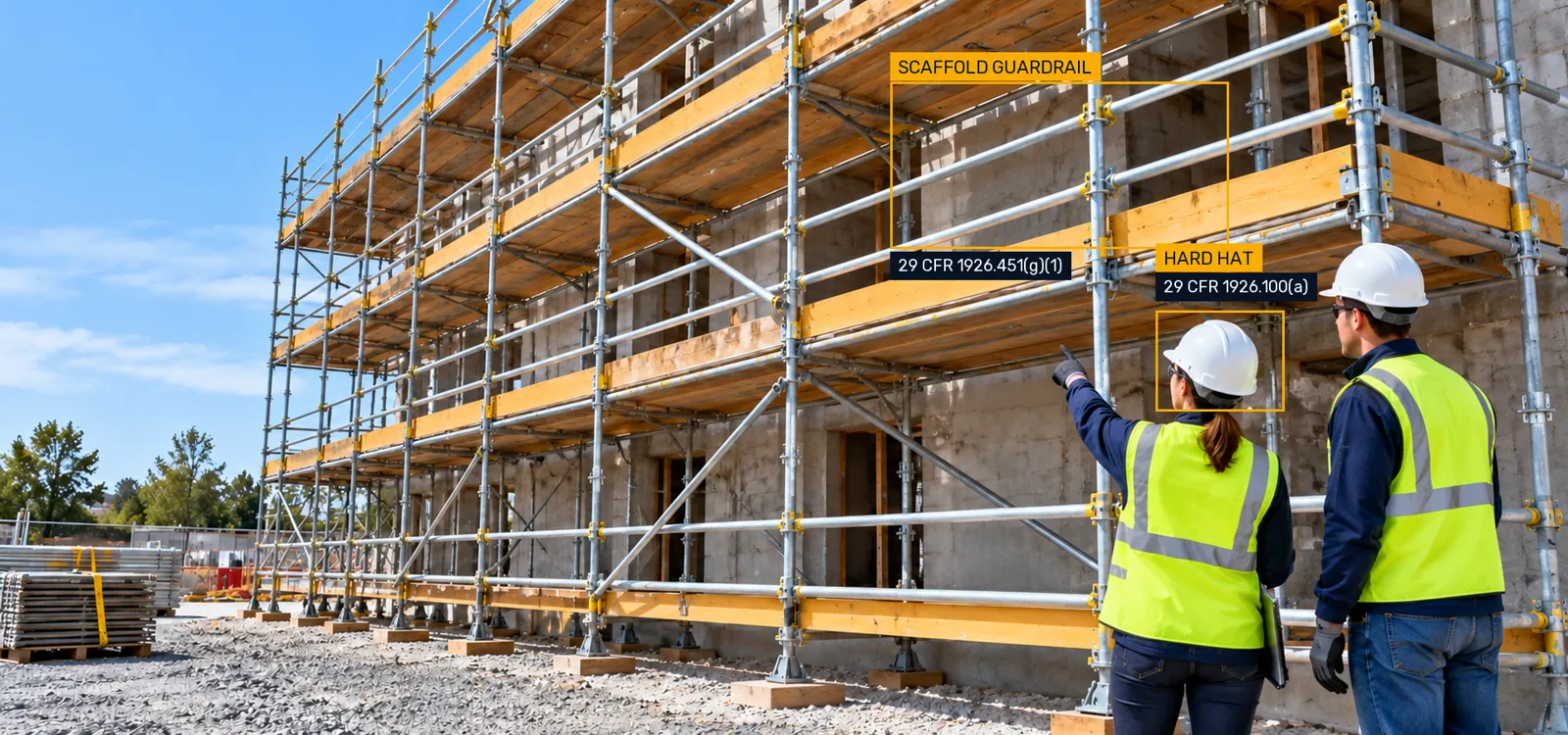
Osha Ask reviews job site video and photos and checks what it sees against OSHA requirements. It flags hazards and missing safety measures so your safety team can act on them sooner.
Review visible guardrails, PPE and fall-protection measures for the scaffold activity, using the related rule to assess the concern.
Explore OSHA compliance software and AI video safety monitoring for construction to see the conditions we check and the OSHA rules behind them.
Book a demo to discuss video and photo review for your construction team.
Osha Ask is an independent software product and is not affiliated with OSHA or the U.S. Department of Labor.