As of October 2026, federal OSHA lists a maximum of $16,550 per violation for serious, other-than-serious and posting violations, and $165,514 per violation for willful or repeated violations. Failure to abate has a separate daily maximum. These are maximum amounts, not a fixed charge for every citation. Checked October 23, 2026. OSHA Penalties
OSHA lists these maximum amounts for penalties assessed after January 15, 2026 (OSHA penalties page, checked October 2026). OSHA Penalties
This article is general information, not legal advice.
Current Federal Maximum Penalties
The amounts and units below reproduce OSHA's published maximum-penalty table as of October 2026:
| Type Of Violation | Maximum Penalty |
|---|---|
| Serious | $16,550 per violation |
| Other-Than-Serious | $16,550 per violation |
| Posting Requirements | $16,550 per violation |
| Failure to Abate | $16,550 per day beyond the abatement date |
| Willful or Repeated | $165,514 per violation |
Source for every amount and unit: OSHA Penalties. The regulation also states the adjusted amounts by category. 1903.15(d)(1) Through (6)
Read the category and the unit together. A per-violation maximum differs from a per-day failure-to-abate amount. A construction inspection may involve more than one citation item, and the documents identify what is alleged and the proposed penalty for each item.
What A Serious Violation Means
A serious violation involves a substantial probability that death or serious physical harm could result from the condition or practice, unless the employer did not and could not, with reasonable diligence, know of the violation. OSHA Violation Definitions
The classification concerns the hazard and the legal criteria. It does not depend on waiting for a worker to be hurt. Review the condition identified in the citation and the requirement cited, then identify the people who know the work and the response needed.
Keep the practical review specific. The location, task, affected workers and protection in place matter when the business examines what happened and what needs correction.
What Other-Than-Serious Means
An other-than-serious violation has a direct and immediate relationship to worker safety or health, but the likely resulting injury or illness would probably not cause death or serious physical harm. OSHA can still propose a penalty. OSHA Violation Definitions
The label does not mean the condition can be left unresolved. Read the citation and its instructions, identify the required action and keep the response with the people responsible for it. The maximum table shows that this category can still carry a substantial proposed penalty.
Willful And Repeated Violations
A willful violation involves intentional disregard of the law's requirements or plain indifference to employee safety and health. OSHA Violation Definitions
A repeated violation involves a previous citation for the same or a substantially similar condition or hazard that has become a final order before the later violation. OSHA's Field Operations Manual explains the criteria and policy for identifying repeated violations. OSHA FOM Chapter 4, Repeated Violations
These classifications require their own assessment. A business should review the actual citation, the prior case where relevant and the official instructions. Keep records of the condition and correction clear across projects and supervisors so the next team understands what was addressed.
Failure To Abate Is About An Uncorrected Condition
Failure to abate concerns a previously cited condition that remains continuously uncorrected. A condition corrected and then recurring is treated differently under the repeated-violation framework. OSHA FOM Chapter 4, Repeated Versus Failure To Abate
OSHA's maximum table lists $16,550 per day beyond the abatement date. Review the actual citation and the applicable agency instructions for the response required. OSHA Penalties
Keep the abatement date and the action required visible to the responsible team. Identify who checks the completed correction and who handles the formal response. An unresolved handoff can leave the business unclear about whether the cited condition has actually been corrected.
How A Proposed Amount Is Determined
The Area Director considers the employer's business size, the gravity of the violation, good faith and previous violation history when determining a proposed penalty. The regulation also permits proposed penalties even when the employer immediately corrects or starts correcting a condition after being informed of it. 1903.15(b), (c)
Use the current official policy and the actual citation to understand the amount proposed. A maximum table alone cannot calculate the result for a particular inspection. This article does not estimate an average construction fine or a likely discount.
Read The Citation And Arrange The Response
| Item To Identify | Practical Question |
|---|---|
| Cited condition | Which task and location are involved? |
| Standard | What requirement does the citation identify? |
| Classification | Which violation category is alleged? |
| Proposed penalty | What amount and unit are stated? |
| Abatement | What correction and date are specified? |
| Response responsibility | Who handles the site action and formal documents? |
An employer's written notice of intent to contest must be postmarked within 15 working days of receipt of the proposed-penalty notice. 1903.17(a)
Abatement verification addresses the employer's certification of correction, supporting documentation where required and notice to affected employees. Read the applicable duties and exceptions in the provision. 1903.19(c), (d), (g)
Our construction inspection guide explains the inspection stages. For agency clarification, use the official contact routes.
State Plan Penalties
OSHA says State Plans must adopt maximum penalty levels at least as effective as federal OSHA's. They are not required to impose monetary penalties on state and local government employers. Use the responsible program's current instructions for a state-covered workplace. OSHA Penalties, State Plans
For New Jersey, our construction coverage guide explains the distinction between federal private-sector coverage and the state's public-employee program.
Keep Prevention Connected To The Work
Use the construction safety compliance guide to organize the daily review of site conditions. Identify hazards, involve the responsible people and check the response as work areas change.
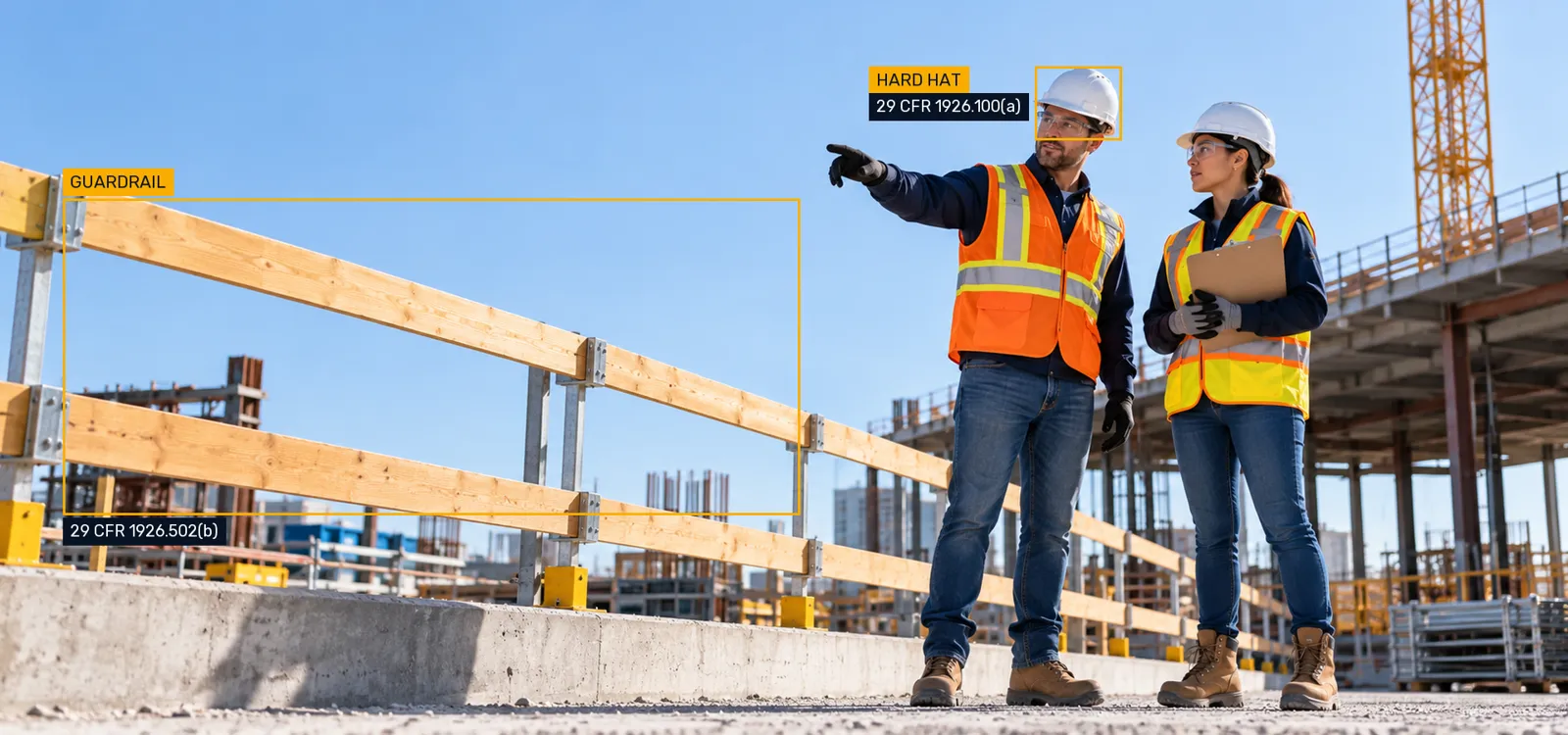
Osha Ask reviews job site video and photos and checks what it sees against OSHA requirements. It flags hazards and missing safety measures so your safety team can act on them sooner. Each flag shows the related OSHA rule.
AI helps your safety team see more; your people still make the call.
Explore OSHA compliance software and AI video safety monitoring.
Osha Ask is an independent software product and is not affiliated with OSHA or the U.S. Department of Labor.